Artificial intelligence has been part of everyday technology for years, but Generative AI has made AI much more visible and accessible to ordinary users. Tools such as ChatGPT, Google Gemini, Claude, Adobe Firefly, and AI coding assistants can now create text, images, code, audio, and other types of content from simple instructions.
. What exactly is Generative AI? How does it work? What can it create?. What are its limitations?
In this guide we’ll explain what Generative AI means. We’ll also look at how it works. We’ll cover the types. We’ll share real-world examples. We’ll talk about the benefits. We’ll discuss the limitations. We’ll look at the risks.. We’ll explore future possibilities. All, in words.
Also Read: Best AI Productivity Tools
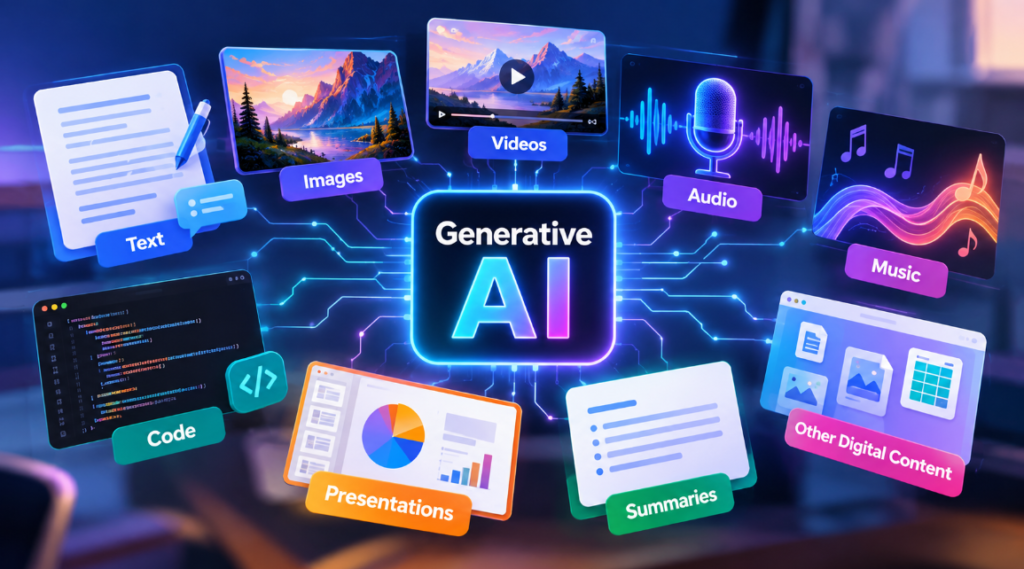
Depending on the system, that content can include:
- Text: Emails, articles, answers, summaries, and other written content.
- Images: Illustrations, designs, graphics, and other visuals.
- Videos: Short video clips, animations, and visual content.
- Audio: Synthetic speech, voiceovers, and sound effects.
- Music: Songs, background music, and instrumental tracks.
- Computer Code: Functions, scripts, queries, and code snippets.
- Presentations: Slides, outlines, speaker notes, and presentation content.
- Summaries: Short versions of articles, documents, reports, and transcripts.
- Other Digital Content: Marketing materials, captions, structured content, and more.
For example, you can ask a text-based AI:
“Write a professional email asking a customer to reschedule a meeting.”
The AI can generate an email based on your instructions.
You could also ask an image-generation system:
“Create a realistic image of a modern office overlooking a city at sunset.”
The system can generate an image based on that description.
I notice that coding assistant can generate a programming function. I also see that AI system can create a voiceover or music based on user instructions.
This ability to generate new content is the defining feature of Generative AI.
Table of Contents
What Can Generative AI Create?
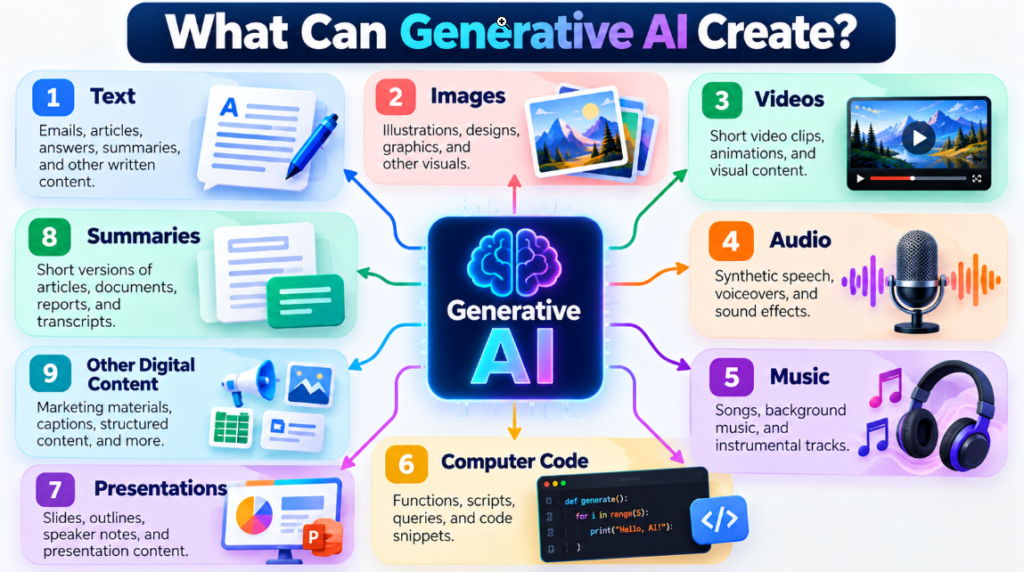
Generative AI is not limited to chatbots or written answers. Different AI models specialize in different types of content.
Let’s look at the major categories in detail.
1. Generative AI for Text
Text generation is probably the most familiar application of Generative AI.
AI language models can generate and transform written content based on natural-language instructions.
For example, you can ask an AI to:
“Write a 500-word beginner-friendly article explaining cloud computing.”
The AI can generate a structured explanation based on the prompt.
What Can AI Text Generation Do?
Generative AI can assist with:
- Blog posts
- Articles
- Emails
- Product descriptions
- Social media captions
- Stories
- Scripts
- Reports
- Study notes
- Summaries
- Brainstorming
- Rewriting
- Translation
- Grammar improvement
- Question answering
Example
Suppose you have written this sentence:
“Our company is launching a new software product next month.”
You could ask AI to turn it into a professional announcement.
The AI may expand the idea into a complete announcement with a headline, introduction, product description, and call to action.
Where Is Text Generation Used?
Text-generation AI is widely useful in:
Education:
Students can use it to understand difficult topics, create study material, or summarize information.
Business:
Companies can use it to draft emails, reports, product descriptions, and internal documents.
Marketing:
Marketing teams can generate campaign ideas, advertisements, social media content, and blog outlines.
Customer support:
AI can help generate responses to common customer questions.
Important Limitation
AI-generated text can sound confident even when some information is incorrect. Therefore, important facts should be checked before publishing or relying on them.
2. Generative AI for Images
AI image generation allows users to create images from text descriptions.
Instead of manually designing every visual element, users can describe what they want.
For example:
“A futuristic city at night with neon buildings, flying cars, and heavy rain.”
An image-generation model can interpret the concepts in the prompt and produce an image based on the description.
What Can AI Image Generators Create?
Depending on the tool, AI can generate:
- Photorealistic images
- Illustrations
- Digital art
- Concept art
- Product concepts
- Characters
- Backgrounds
- Posters
- Marketing graphics
- Social media visuals
- Website graphics
AI image tools can also support editing.
For example, you may be able to:
- Remove an object
- Change a background
- Add an object
- Modify lighting
- Expand an image
- Change a visual style
- Create variations
Example for a Website
Suppose you are writing an article about Generative AI.
Instead of using a generic stock image, you could generate a visual showing:
Text → AI Model → Image
This can create a more relevant visual for the article.
Where Are AI Images Used?
AI-generated images are increasingly useful for:
- Websites
- Blogs
- YouTube thumbnails
- Advertising
- Social media
- Product concepts
- Graphic design
- Presentations
- Creative projects
However, users should pay attention to copyright, licensing, commercial-use rules, and the terms of the specific AI image service.
3. Generative AI for Video
AI video generation is another rapidly developing area of Generative AI.
Video-generation systems can use text, images, or other inputs to create or modify video content, depending on the particular tool.
For example, a user might provide a prompt such as:
“Aerial view of a futuristic city at sunset with flying vehicles.”
An AI video system may generate a short video sequence based on that description.
What Can AI Video Tools Do?
Depending on the platform, AI video tools can help with:
- Text-to-video generation
- Image-to-video animation
- Short video clips
- Visual effects
- Background changes
- Video editing
- Character animation
- Marketing videos
- Product demonstrations
Practical Uses
YouTube:
Creators can develop visual scenes and supporting footage.
Marketing:
Businesses can create promotional videos and advertisements.
Education:
Teachers and content creators can create visual explanations.
Film and creative work:
AI can be used for storyboarding, concept development, and experimental visuals.
Current Limitations
AI video generation can still have problems with:
- Consistency between frames
- Human movements
- Hands and facial details
- Objects changing unexpectedly
- Text appearing incorrectly
- Maintaining the same character across scenes
Video-generation technology is developing quickly, so capabilities can change considerably over time.
4. Generative AI for Audio
Generative AI can also create and manipulate audio.
Audio-generation systems can work with spoken language, sound effects, voices, and other forms of audio depending on their design.
AI Audio Applications
Generative AI can help create:
- Voiceovers
- Narration
- AI-generated speech
- Sound effects
- Audio content
- Voice transformations
- Speech-related applications
For example, a YouTube creator could write a script and use an AI voice-generation tool to produce narration.
Why Is AI Audio Useful?
AI-generated audio can help creators who:
- Don’t have access to professional voice talent
- Need multiple language versions
- Want to create quick voiceovers
- Need narration for educational content
- Want to experiment with different voices
However, voice-related AI also raises important questions around consent, identity, impersonation, and misuse.
Users should only use voices and voice-cloning features in accordance with the applicable laws and the service’s rules.
5. Generative AI for Music
Generative AI can also be used to create music.
Depending on the system, users may be able to describe a desired style, mood, or type of music and receive an AI-generated result.
For example:
“Create calm background music suitable for a technology explainer video.”
An AI music system may generate a piece of music matching those instructions.
Possible Uses of AI Music
AI-generated music can be useful for:
- YouTube videos
- Podcasts
- Background music
- Advertisements
- Games
- Creative projects
- Demonstrations
- Early musical experimentation
Important Consideration
Music generation involves copyright and licensing questions. Before using AI-generated music commercially, users should check the specific platform’s licensing terms rather than assuming every generated track is automatically free for commercial use.
6. Generative AI for Computer Code
Generative AI is also becoming an important tool for software developers.
AI coding assistants can generate code from natural-language instructions.
For example, a developer could ask:
“Create a Python function that calculates the average of a list of numbers.”
The AI can produce a possible implementation.
What Can AI Coding Tools Do?
They can assist with:
- Writing code
- Explaining code
- Debugging
- Generating functions
- Creating test cases
- Writing documentation
- Converting code between languages
- Suggesting improvements
- Understanding programming errors
Example
A beginner might paste an error message into an AI assistant and ask:
“Explain this error and show me how to fix it.”
The AI can explain what may have caused the problem and suggest possible solutions.
Can AI Replace Developers?
AI coding tools can automate parts of programming, but software development involves much more than generating code.
Developers still need to:
- Understand requirements
- Design systems
- Review generated code
- Test applications
- Consider security
- Maintain software
- Make technical decisions
AI-generated code can also contain bugs or security problems, so it should be reviewed and tested.
7. Generative AI for Presentations
Generative AI can also help create presentations.
Instead of manually creating every slide, a user can provide a topic and ask an AI presentation tool to generate an initial structure.
For example:
“Create a presentation about the benefits and risks of Artificial Intelligence for university students.”
An AI presentation tool may generate:
- A title slide
- Section headings
- Slide content
- Visual suggestions
- Speaker notes
- Layouts
Where Can AI Presentations Be Used?
They can help with:
- School projects
- University presentations
- Business meetings
- Sales presentations
- Training material
- Marketing presentations
- Educational content
The generated presentation should still be reviewed because AI may create inaccurate facts, unsuitable visuals, or unnecessary content.
8. Generative AI for Summaries
Another very practical use of Generative AI is summarization.
AI can process a long piece of information and produce a shorter version containing the main points.
For example, you could provide a long meeting transcript and ask:
“Summarize this meeting and list the decisions and action items.”
The AI could organize the information into:
Meeting Summary
A short overview of what was discussed.
Key Decisions
The important decisions made during the meeting.
Action Items
Tasks that need to be completed.
Follow-Up
Issues that need further discussion.
This can save considerable time when dealing with long documents, meetings, reports, or research material.
However, summaries should be checked when missing a small detail could change the meaning of the original information.
How Does Generative AI Work?
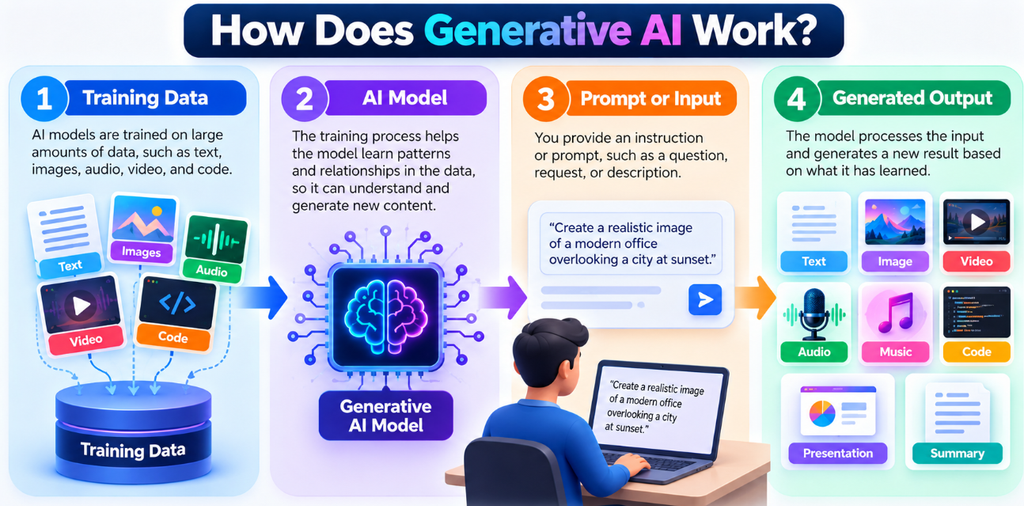
Although different Generative AI systems use different technologies, the basic workflow can be understood through four stages.
1. Training Data
AI models are trained using large amounts of data relevant to their intended purpose.
For example, language models learn from large amounts of language-related data, while image models learn from visual information.
During training, the model learns patterns and relationships within the data.
2. AI Model
The training process produces a model capable of processing new input.
For example, a language model can process a user’s question and generate a response.
An image model can process a text description and generate an image based on the concepts in that description.
3. Prompt or Input
The user provides an instruction.
For example:
“Explain Generative AI to a beginner.”
The clearer the instruction, the easier it is for the AI system to understand the intended task.
4. Generated Output
The model processes the input and generates an output.
The output could be:
- Text
- Image
- Video
- Audio
- Music
- Code
- Presentation
- Summary
The exact capabilities depend on the AI system being used.
Generative AI vs Traditional AI
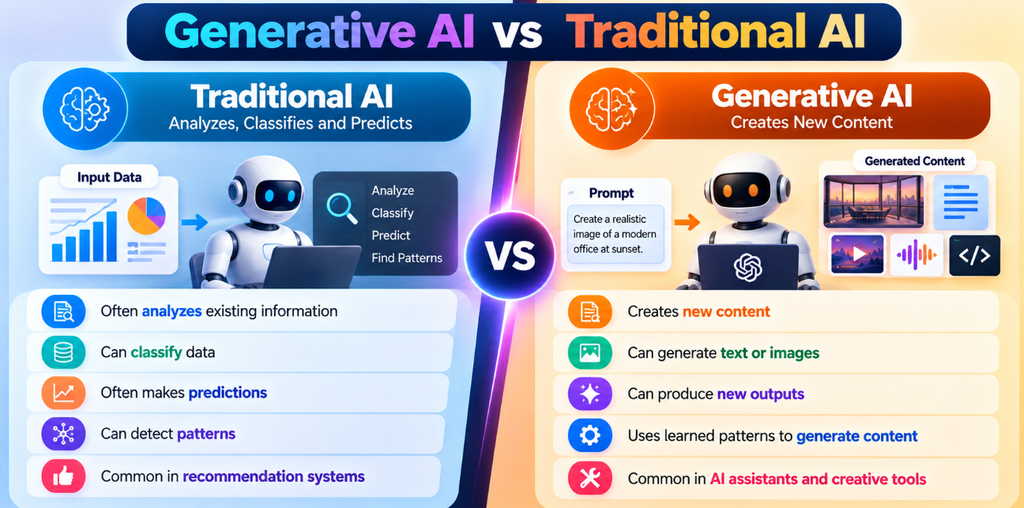
Generative AI and traditional AI can both process information, but their common applications are different.
| Traditional AI | Generative AI |
|---|---|
| Often analyzes existing information | Creates new content |
| Can classify data | Can generate text or images |
| Often makes predictions | Can produce new outputs |
| Can detect patterns | Uses learned patterns to generate content |
| Common in recommendation systems | Common in AI assistants and creative tools |
For example, a traditional recommendation system might predict which movie you are likely to enjoy.
A Generative AI system could create a movie summary, write a review draft, or generate a fictional story inspired by a particular genre.
The distinction is not absolute because modern AI systems can combine analytical and generative capabilities.
Generative AI vs AI vs Machine Learning vs Deep Learning
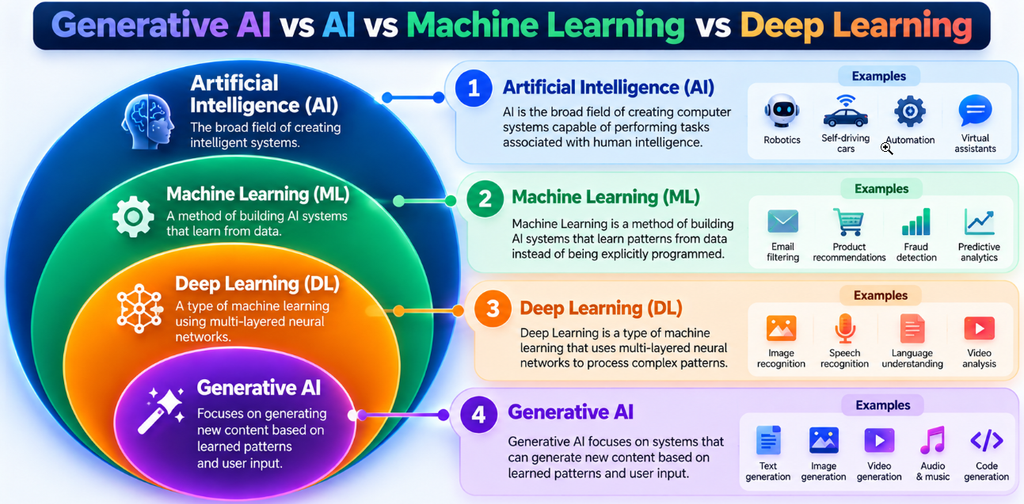
These terms are related but have different meanings.
Artificial Intelligence
AI is the broad field of creating computer systems capable of performing tasks associated with human intelligence.
Machine Learning
Machine Learning is a method of building AI systems that learn patterns from data.
Deep Learning
Deep Learning is a type of machine learning that uses multi-layered neural networks to process complex patterns.
Generative AI
Generative AI focuses on systems that can generate new content based on learned patterns and user input.
So, Generative AI is not a replacement for the term AI. It is a specific category within the broader AI landscape.
Popular Generative AI Tools
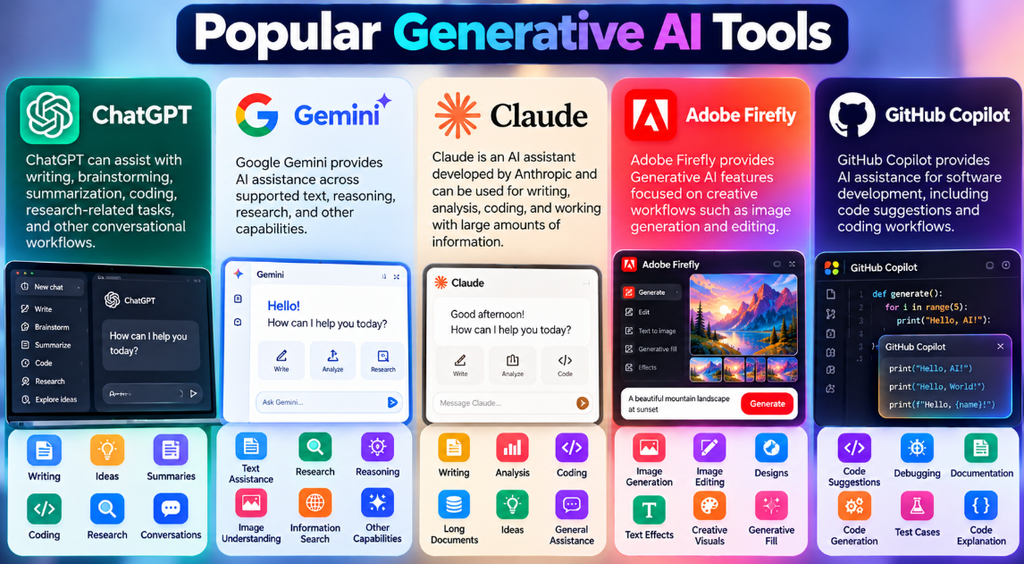
There are now many Generative AI products, each designed for different tasks.
ChatGPT
ChatGPT can assist with writing, brainstorming, summarization, coding, research-related tasks, and other conversational workflows.
Google Gemini
Google Gemini provides AI assistance across supported text, reasoning, research, and other capabilities.
Claude
Claude is an AI assistant developed by Anthropic and can be used for writing, analysis, coding, and working with large amounts of information.
Adobe Firefly
Adobe Firefly provides Generative AI features focused on creative workflows such as image generation and editing.
GitHub Copilot
GitHub Copilot provides AI assistance for software development, including code suggestions and coding workflows.
The features, pricing, limits, and availability of these products can change over time.
Also Read: Best AI Chatbots 2026: 10 Best AI Assistants Compared
Real-World Applications of Generative AI
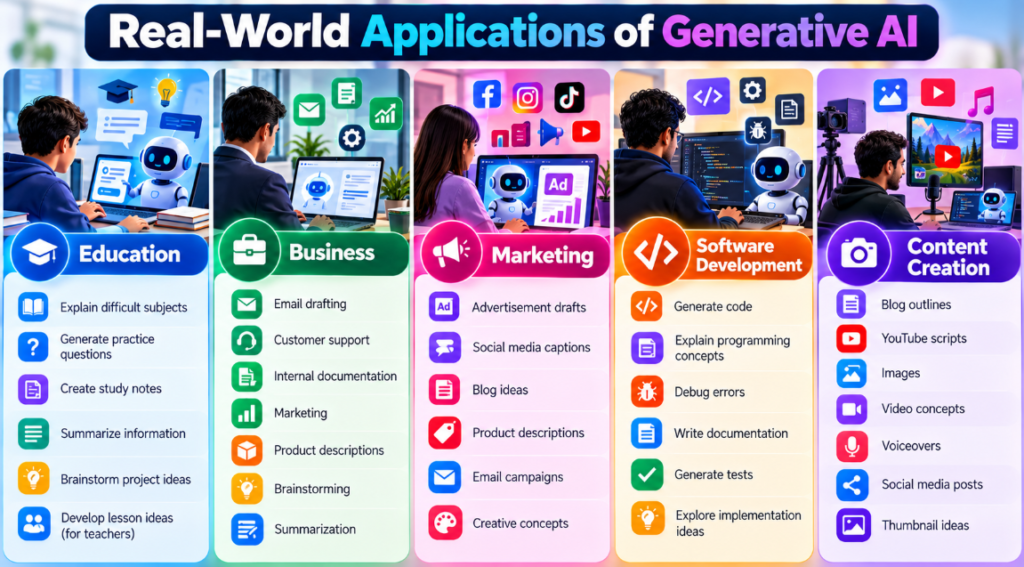
Generative AI is already being used across many industries.
Education
Students can use AI to:
- Explain difficult subjects
- Generate practice questions
- Create study notes
- Summarize information
- Brainstorm project ideas
Teachers can also use AI to develop lesson ideas and educational material.
Business
Businesses can use Generative AI for:
- Email drafting
- Customer support
- Internal documentation
- Marketing
- Product descriptions
- Brainstorming
- Summarization
Marketing
Marketing teams can use AI to create:
- Advertisement drafts
- Social media captions
- Blog ideas
- Product descriptions
- Email campaigns
- Creative concepts
Human review remains important to maintain brand consistency and factual accuracy.
Software Development
Developers can use AI to:
- Generate code
- Explain programming concepts
- Debug errors
- Write documentation
- Generate tests
- Explore implementation ideas
Content Creation
Content creators can use Generative AI for:
- Blog outlines
- YouTube scripts
- Images
- Video concepts
- Voiceovers
- Social media posts
- Thumbnail ideas
Benefits of Generative AI
Faster Content Creation
AI can create an initial draft quickly, reducing the time required for repetitive tasks.
Increased Productivity
Routine activities such as summarizing, drafting, rewriting, and brainstorming can become faster.
Easier Access to Creative Tools
People without advanced design, writing, or programming skills can experiment with tasks that previously required specialized software or expertise.
Brainstorming
AI can provide multiple ideas when a person needs inspiration.
Personalized Assistance
AI can adapt its output based on the user’s instructions, audience, format, and preferred level of detail.
Learning Support
Generative AI can explain concepts in different ways, making it useful as an additional learning tool.
Limitations of Generative AI
Generative AI has impressive capabilities, but it also has limitations.
It Can Generate Incorrect Information
An AI system may produce an answer that sounds convincing but is factually wrong.
It Does Not Understand Everything Like a Human
AI systems process patterns and relationships in data, but this does not mean they possess human experience or understanding.
Results Can Vary
Two prompts that look similar may produce different results.
Human Review Is Still Necessary
Important information should be checked before publication or use.
AI Can Struggle With Context
Highly specialized, ambiguous, or unusual requests may produce weaker results.
Risks of Generative AI
Generative AI also creates important risks.
Misinformation
AI can produce false information quickly and at scale.
Bias
AI systems can reproduce biases present in their training data or development processes.
Privacy
Users should be careful about entering personal, confidential, or sensitive information into AI services.
Copyright
AI-generated content can raise questions around copyright, licensing, ownership, and training data.
Security
Generative AI can be used for legitimate security and development work but can also be misused.
Deepfakes
AI-generated images, voices, and videos can potentially be used to create misleading or deceptive media.
Overdependence
Relying too heavily on AI may reduce opportunities to develop independent writing, research, reasoning, and problem-solving skills.
Is Generative AI Always Accurate?
No.
Generative AI can make mistakes.
This is particularly important when dealing with:
- Medical information
- Financial information
- Legal information
- Scientific claims
- Current events
- Technical specifications
For important decisions, AI-generated information should be checked against reliable and current sources.
Can Generative AI Replace Human Creativity?
Generative AI can produce creative-looking content, but human creativity still plays an important role.
Humans provide:
- Goals
- Context
- Personal experience
- Judgment
- Taste
- Direction
- Responsibility
AI can generate many possibilities, but a human often needs to decide which ideas are useful, accurate, appropriate, or meaningful.
For many users, the most practical approach is to combine human creativity with AI assistance.
How to Use Generative AI Responsibly
A few simple practices can make Generative AI more useful and safer.
Write Clear Prompts
Give the AI enough context to understand what you actually need.
Check Important Facts
Never assume that fluent AI-generated text is automatically accurate.
Protect Private Information
Avoid sharing passwords, confidential documents, sensitive personal information, or other private data unless you understand the service’s data practices.
Review Before Publishing
Check AI-generated content for:
- Accuracy
- Grammar
- Context
- Tone
- Copyright concerns
- Unnecessary claims
Add Human Input
Use AI as an assistant rather than blindly publishing everything it produces.
What Is the Future of Generative AI?
Generative AI is still evolving rapidly.
Future systems may become increasingly capable of working across multiple formats at the same time.
For example, a single AI system could potentially work with:
Text + Images + Audio + Video + Code
This is often described as multimodal AI.
Generative AI is also becoming integrated into everyday software, search, smartphones, browsers, design applications, productivity tools, and development environments.
At the same time, issues such as privacy, copyright, security, misinformation, employment, and responsible AI use will remain important.
The future of Generative AI will therefore depend not only on how powerful the technology becomes, but also on how responsibly people and organizations use it.
Frequently Asked Questions
What is Generative AI in simple words?
Generative AI is a type of artificial intelligence that can create new content such as text, images, video, audio, music, and code from instructions or other input.
What are examples of Generative AI?
Examples include ChatGPT, Google Gemini, Claude, Adobe Firefly, and AI coding assistants such as GitHub Copilot.
What can Generative AI generate?
Depending on the system, Generative AI can generate text, images, video, audio, music, computer code, presentations, summaries, and other digital content.
Is ChatGPT Generative AI?
Yes. ChatGPT is an example of a Generative AI application that can generate and transform content based on user instructions.
Can Generative AI create images?
Yes. Many AI image-generation systems can create images from text descriptions and may also provide editing capabilities.
Can Generative AI create videos?
Yes. Some Generative AI systems can generate or modify video using text, images, or other inputs.
Can Generative AI write computer code?
Yes. AI coding tools can generate, explain, modify, and assist with computer code.
What are the biggest risks of Generative AI?
Major concerns include inaccurate information, bias, privacy, copyright, misinformation, security misuse, deepfakes, and overdependence on AI.
Will Generative AI replace humans?
Generative AI can automate and assist with many tasks, but human judgment, creativity, accountability, and decision-making remain important.
Conclusion
Generative AI is one of the most significant developments in modern artificial intelligence. Unlike AI systems that primarily analyze or classify existing information, Generative AI can create new content from user instructions.
Today, this technology can generate everything from articles and emails to images, videos, music, voices, presentations, summaries, and computer code.
Its applications extend across education, business, marketing, software development, design, research, and content creation.
However, Generative AI is not perfect. It can produce incorrect information, reflect bias, raise privacy and copyright concerns, and potentially be misused.
For that reason, the best way to use Generative AI is not to treat it as an unquestionable authority. Instead, use it as a powerful assistant, verify important information, protect sensitive data, and apply human judgment to the final result.
As the technology continues to develop, understanding both its capabilities and limitations will become increasingly important for anyone using modern digital tools.
Pingback: What Is an AI Agent? Definition, Examples, Types & Risks - AI Crest Lab