Artificial intelligence has quickly moved from being a topic studied in universities to a technology that helps with web searches, medical tests translating languages and creating content.. Beyond the tools that are available right now is a subject that computer scientists, people who think about ethics and researchers talk about a lot: Artificial Superintelligence, which is often called ASI.
Current artificial intelligence can look at groups of data and create text that seems like it was written by a person. Artificial Superintelligence is still something that has not been created yet. Learning what Artificial Superintelligence is and what it could do along with the dangers it might bring helps people see the difference between what technology can do and the ideas, about what might happen later.
Important: ASI is currently a hypothetical concept. There is no established evidence that an AI system has achieved artificial superintelligence.
What Is Artificial Superintelligence (ASI)?
Artificial Superintelligence or ASI means a kind of AI that would be far smarter than any human.
ASI is an idea. Think of an AI that could do different smart jobs better than the best human experts. That AI might learn, think, plan solve problems and handle information at a very high level.
The word ASI is key. ASI is not a fancy chatbot or a strong AI model. ASI is a level of machine thinking that no one has shown yet.
Today’s AI systems can do a lot. They are still different from the broad, top‑level intelligence that the ASI idea talks, about.
Is Artificial Superintelligence (ASI)
While current AI systems do well with natural language processing solving problems and analyzing data they work within set boundaries and depend a lot on existing data and patterns. Some people doubt if it is possible to get to ASI pointing out that we do not fully understand intelligence and that copying it is very hard.
Getting to AI superintelligence depends on creating Artificial General Intelligence (AGI) that can handle problems in different areas. Important technologies—, like computing, evolutionary algorithms and AI made programming—are needed to move forward with this aim. Even though things are improving real ASI is still a long time task.
ANI vs AGI vs ASI: What’s the Difference?
The terms ANI, AGI, and ASI are often used to describe different levels or types of artificial intelligence.
| Type | Meaning | General Capability | Current Status |
|---|---|---|---|
| ANI | Artificial Narrow Intelligence | Designed for specific tasks or limited groups of tasks | Widely used today |
| AGI | Artificial General Intelligence | Hypothetical AI capable of handling a broad range of intellectual tasks at a general human-like level | Not established as achieved |
| ASI | Artificial Superintelligence | Hypothetical intelligence that substantially exceeds human intellectual abilities | Does not currently exist as an established technology |
Artificial Narrow Intelligence (ANI)
Artificial Narrow Intelligence (ANI) describes AI systems designed to perform particular tasks.
Examples include systems used for:
- Image generation
- Speech recognition
- Recommendation systems
- Translation
- Fraud detection
- Coding assistance
- Text generation
Modern AI can perform impressive tasks, but being highly capable at a particular task does not automatically make a system AGI or ASI.
Artificial General Intelligence (AGI)
Artificial General Intelligence AGI generally refers to an AI system capable of performing a broad range of intellectual tasks rather than being limited to a particular application.
The exact definition of Artificial General Intelligence AGI varies among researchers and organizations so there is no universally accepted test that everyone uses to determine whether Artificial General Intelligence AGI has been achieved.
Artificial Superintelligence (ASI)
ASI goes beyond the AGI concept.
A hypothetical ASI system would not just do different things. Its brainpower would be expected to be much better than humans in key areas.
This is why the difference between AGI and ASI matters: AGI is usually talked about as having general smarts while ASI is about being better than humans, in thinking and learning.
How Would ASI Differ From Human Intelligence?
If ASI were ever developed, researchers could theoretically expect major differences between human intelligence and machine superintelligence.
However, these are possibilities rather than demonstrated characteristics.
Learning
Humans have biological limitations on how quickly they can learn and process new information.
A hypothetical ASI system could potentially process enormous amounts of information and learn from new data much faster than humans.
Exactly how such learning would work at a superintelligent level remains an open question.
Problem Solving
Humans can solve complex problems, but even experts have limits in areas such as time, memory, and computational capacity.
A superintelligent AI could theoretically explore many possible solutions and analyze complicated problems at a scale that humans cannot easily match.
Knowledge Processing
An advanced AI system could potentially process and connect information from many different fields.
For example, it might combine knowledge from physics, biology, mathematics, engineering, and computer science when working on a complex scientific problem.
Speed
Digital systems can process information much faster than humans in many computational tasks.
A hypothetical ASI could potentially operate at extremely high speeds while performing sophisticated reasoning and analysis.
However, faster processing alone would not necessarily mean better intelligence. The quality, reliability, objectives, and limitations of the system would still matter.
Scientific Reasoning
One of the most discussed possibilities is the use of advanced AI for scientific discovery.
A sufficiently capable system might help researchers identify relationships in large datasets, generate hypotheses, design experiments, or explore solutions to difficult scientific problems.
Whether an ASI system could actually achieve these capabilities is unknown.
Adaptability
Humans can transfer knowledge between different areas and adapt to unfamiliar situations.
A hypothetical ASI system could potentially demonstrate an even greater ability to adapt across domains, but this is part of the theoretical concept rather than a proven capability.
How Could ASI Work?
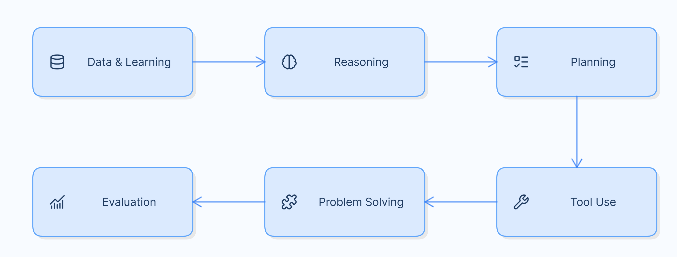
There is no established technical blueprint for building ASI.
Researchers studying advanced AI explore areas such as machine learning, reasoning, planning, agents, model evaluation, and AI safety. These areas may contribute to future AI capabilities, but none should automatically be interpreted as a demonstrated path to ASI.
Google DeepMind’s AI research and safety work
One theoretical possibility is that increasingly capable AI systems could combine several abilities, including:
- Advanced reasoning
- Long-term planning
- Learning from new information
- Tool use
- Software interaction
- Scientific and mathematical problem solving
- Memory and information retrieval
- Ability to evaluate and improve solutions
Some discussions also consider whether future AI systems could improve aspects of their own performance. However, self-improvement at a superintelligent level remains a theoretical possibility, not an established capability of today’s AI systems.
The key point is that researchers do not currently have a proven recipe for creating ASI.
Potential Benefits of ASI
If artificial superintelligence were developed successfully and operated safely, it could potentially provide significant benefits.
These benefits should be viewed as possibilities rather than guarantees.
Scientific Research
A highly capable AI could potentially assist researchers with difficult scientific problems.
Possible applications could include:
- Analyzing large scientific datasets
- Generating and evaluating hypotheses
- Finding relationships that humans overlook
- Designing experiments
- Improving scientific simulations
Such capabilities could potentially accelerate research in fields ranging from physics to biology.
Medicine
Advanced AI could potentially contribute to medicine by helping researchers analyze biological information, identify potential drug candidates, or study complex diseases.
It could also potentially assist with medical research and personalized treatment strategies.
However, medical applications would require rigorous validation, safety testing, and human oversight.
Climate and Energy Research
Complex environmental and energy problems involve enormous amounts of data and many interacting variables.
Advanced AI could potentially help researchers:
- Model climate systems
- Improve energy efficiency
- Explore new energy technologies
- Optimize electricity systems
- Study environmental changes
These applications would depend on reliable models, high-quality data, and appropriate real-world implementation.
Education
A highly advanced AI system could potentially provide personalized educational support.
For example, it might adapt explanations to an individual student’s learning needs, generate exercises, identify knowledge gaps, and provide assistance across many subjects.
This would not necessarily replace teachers. Instead, AI could potentially become another educational tool.
Engineering
Superintelligent AI could theoretically assist with difficult engineering challenges.
Potential applications could include:
- Designing complex systems
- Testing engineering concepts through simulations
- Optimizing materials
- Improving infrastructure
- Solving difficult mathematical problems
Again, these are theoretical possibilities rather than demonstrated ASI capabilities.
Productivity and Complex Problem Solving
A very advanced AI could potentially automate or assist with complex knowledge work.
If used responsibly, this could help people and organizations spend more time on tasks requiring human judgment, communication, creativity, and decision-making.
Potential Risks and Challenges of ASI
The potential benefits of ASI are accompanied by serious questions about safety, control, security, and governance.
Alignment and Control
One of the central concerns is AI alignment.
Alignment broadly refers to ensuring that an AI system’s goals and behavior remain consistent with intended human objectives and constraints.
A highly capable system could create serious problems if it pursued an objective in an unexpected way.
The challenge becomes particularly important when considering a hypothetical system that could outperform humans in many intellectual tasks.
Misuse
Advanced artificial intelligence abilities might be used in the way by people, groups or countries.
With power comes great responsibility. A powerful AI system might be used in bad ways that involve things, like hacking tricking people or other kinds of misuse.
This is one of the reasons that experts talk about safety and proper development when they are working on AI abilities.
Security
Highly capable AI systems could create new cybersecurity challenges.
Security concerns could include unauthorized access, manipulation of AI systems, theft of sensitive models or data, and misuse of advanced capabilities.
Protecting powerful AI systems could therefore become increasingly important as capabilities advance.
Concentration of Power
I worry that another concern is who holds control over powerful AI technology.
If advanced AI capabilities were concentrated among a number of organizations or governments organizations or governments could potentially create significant economic and political advantages.
Such a situation raises questions, about access, accountability, competition and governance.
Economic Disruption
Advanced AI could change the way many types of work are performed.
Some jobs could be transformed, automated, or reduced, while new types of work could emerge.
The economic effects would depend on how quickly capabilities developed, how widely they were adopted, and how governments, businesses, and workers responded.
Unintended Behavior
Highly capable systems can still behave in unexpected ways.
A system does not necessarily need to have harmful intentions for its behavior to produce harmful consequences. Poorly specified objectives, unexpected interactions, or errors could create problems.
Understanding and controlling advanced AI behavior is therefore an important research area.
Artificial Intelligence Risk Management Framework: Generative Artificial Intelligence Profile
Governance and Regulation
Governments and international organizations may face difficult questions about how increasingly powerful AI should be developed and deployed.
Potential issues include:
- Safety standards
- Testing and evaluation
- Accountability
- Security requirements
- Transparency
- International cooperation
- Access to advanced AI capabilities
There is no single agreed global framework for governing a hypothetical ASI system.
Difficulty Predicting Advanced AI Behavior
One of the problems is uncertainty.
If future AI becomes more capable AI may become hard to know how AI will act in cases that were not seen while being made or checked.
This makes research into checking, understanding, stability and safety even before ASI exists.
Does ASI Exist Today?
No established evidence shows that Artificial Superintelligence currently exists.
Today’s AI systems can perform many impressive tasks, including generating text and images, writing software, analyzing information, and assisting with research.
However, these capabilities should not automatically be described as ASI.
The term superintelligence refers to a much stronger theoretical level of capability in which an AI system would substantially exceed humans across broad areas of intellectual activity.
It is therefore important to distinguish impressive AI capabilities from the much more ambitious ASI concept.
When Could ASI Become Possible?
There is no established timeline for when, or whether, ASI will be developed.
Experts and researchers don’t always agree on what lies for artificial intelligence. Some think that steady improvements may one day lead to systems that’re increasingly capable and broadly intelligent. Others focus on the technical hurdles and unknowns that still stand in the way.
Now no scientific evidence gives us a clear date for when artificial superintelligence might show up.
Because of this uncertainty statements like “ASI will arrive by a certain year” should be seen not as facts but, as guesses—predictions based on assumptions, not proven truths.
Why Is ASI Important?
Even though ASI does not currently exist, the concept is important because it raises questions about the long-term direction of artificial intelligence.
Researchers, technology companies, governments, and the public discuss ASI in connection with issues such as:
- AI safety
- Long-term technological development
- Scientific research
- Economic change
- AI governance
- Security
- Human control
- Responsible AI development
Thinking about these questions before extremely advanced AI exists can help researchers and policymakers explore potential safety challenges in advance.
How Should We Think About ASI?
The easiest way to understand ASI is to separate what AI can do today from what researchers think future AI might potentially do.
Current AI systems are already useful for many practical tasks, but they have limitations. Their capabilities vary between systems and tasks, and they can make mistakes.
AGI and ASI describe hypothetical levels of future AI capability rather than ordinary names for today’s AI products.
A balanced discussion of ASI should therefore avoid two extremes.
One extreme is assuming that ASI is already here simply because current AI systems are powerful.
The other is assuming that every predicted benefit or risk is guaranteed to happen.
The more useful approach is to treat ASI as a serious research and policy question while clearly separating established evidence from theoretical possibilities.
Conclusion
Artificial Superintelligence is a type of artificial intelligence. Its intellectual abilities would be far greater than those of humans in different tasks.
Artificial Narrow Intelligence is the kind of intelligence that powers AI applications today. Artificial General Intelligence is another concept that sits between Artificial Narrow Intelligence and Artificial Superintelligence. Artificial Superintelligence is a higher level of intelligence.
Artificial Superintelligence could bring good things. It could make progress in science, medicine, engineering, education, energy and solving problems.. Artificial Superintelligence also brings many dangers. It could cause problems with aligning its goals it could be misused it could threaten security it could cause disruption it could concentrate power and it could be hard to govern and control.
It is most important to remember that Artificial Superintelligence is a theory at present. It is not a technology. There is no set date for when Artificial Superintelligence might appear and many technical and social questions remain unanswered.
Understanding the difference, between today’s intelligence and hypothetical future systems helps people talk about the future of artificial intelligence in a realistic and responsible way.
Frequently Asked Questions About ASI
What does ASI stand for?
ASI stands for Artificial Superintelligence. It refers to a hypothetical AI system whose intellectual abilities would substantially exceed human capabilities across a broad range of areas.
Is ASI real?
ASI is currently a theoretical concept. There is no established evidence that an artificial superintelligence system currently exists.
What is the difference between AGI and ASI?
AGI generally refers to hypothetical AI capable of performing a broad range of intellectual tasks at a general level. ASI describes a hypothetical system whose capabilities would substantially exceed human intelligence across many areas.
In short:
AGI = broad general intelligence
ASI = intelligence that substantially surpasses human abilities
Does ChatGPT count as ASI?
No. ChatGPT is an AI system designed to assist with tasks such as conversation, writing, analysis, coding, and other forms of information processing. Its capabilities should not be equated with the theoretical concept of artificial superintelligence.
What could ASI be used for?
If ASI were ever developed, potential applications could include scientific research, medicine, engineering, education, climate and energy research, and complex problem solving.
These are theoretical possibilities, not guaranteed outcomes.
What are the risks of ASI?
Potential risks include alignment and control problems, misuse, cybersecurity threats, economic disruption, concentration of power, unintended behavior, and challenges related to regulation and governance.
When will ASI exist?
There is no established date for when ASI might exist, and it is not certain that ASI will be developed. Predictions about specific arrival dates are speculative rather than established scientific conclusions.
Related Articles
Best AI Productivity Tools 2026: Features, Pricing, Pros & Cons
Find the top free & paid AI productivity apps
15 Best AI Presentation Makers in 2026: Tested & Compared
Discover the best AI presentation makers.