Keyword research used to take hours of manual labor: exporting massive spreadsheets, filtering out irrelevant terms, categorizing user intent, and manually grouping hundreds of queries into cohesive topic clusters.
While traditional SEO databases provide critical search volume metrics, turning raw data into an actionable content plan remains a labor-intensive bottleneck.
This is where AI keyword research fundamentally transforms your SEO workflow.
By leveraging generative artificial intelligence, you can compress hours of brainstorming, search intent classification, topic expansion, and semantic clustering into a few minutes.
However, AI tools are not magic buttons. Large language models (LLMs) cannot reliably provide real-time search volume or quantify live search engine rankings on their own.
In this step-by-step guide, you will learn how to use AI for keyword research effectively—from initial seed topic brainstorming and intent classification to validating suggestions with live SEO data and mapping keywords into a production-ready content strategy.
What Is AI Keyword Research?
AI keyword research is the process of using artificial intelligence models—such as ChatGPT, Google Gemini, Claude, or AI-integrated SEO platforms—to assist in generating, categorizing, clustering, and structuring search queries for search engine optimization.
AI-assisted keyword research combines the semantic understanding of AI with real SEO performance data. The AI helps organize and expand ideas, while dedicated SEO platforms provide the metrics needed to decide which keywords are actually worth targeting.
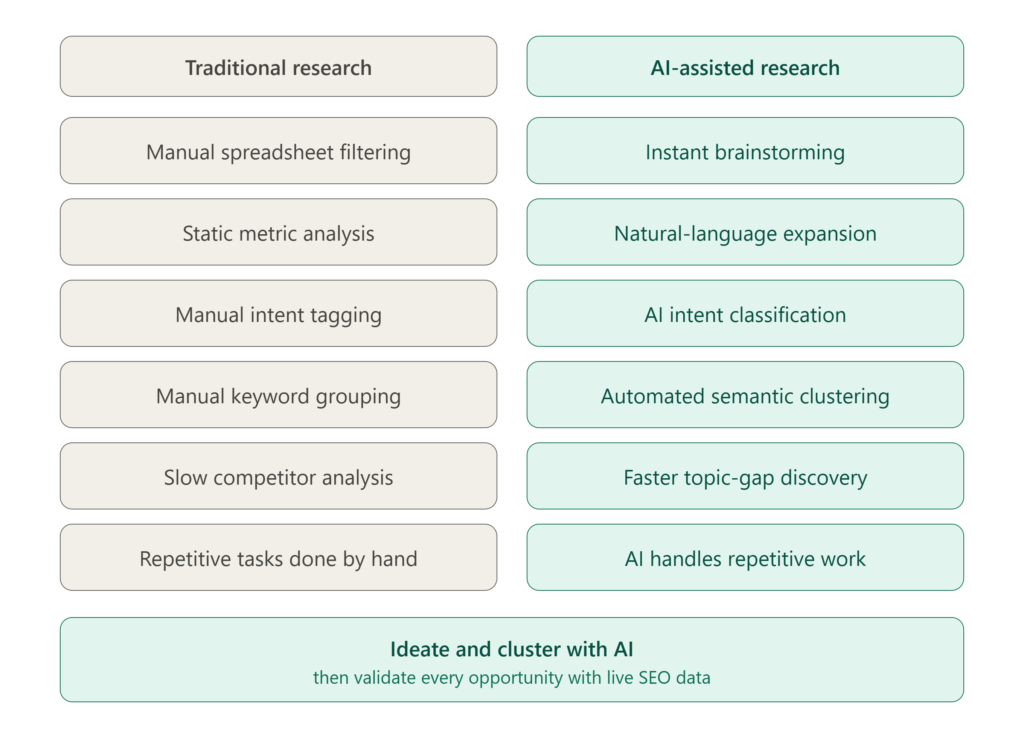
Traditional vs. AI-Assisted Keyword Research
| Traditional Keyword Research | AI-Assisted Keyword Research |
|---|---|
| Manual spreadsheet filtering | Instant semantic clustering and brainstorming |
| Static metric analysis | Natural-language query expansion |
| Manual search-intent tagging | AI-assisted intent classification |
| Manual keyword grouping | Automated semantic clustering |
| Time-intensive competitor analysis | Faster topic-gap discovery |
| Human execution of repetitive tasks | AI handles repetitive analysis while humans make strategic decisions |
The goal is not to eliminate traditional SEO research. Instead, AI makes the research process faster and more structured while live SEO data remains essential for validation.
Key Takeaway: AI is best used as a keyword research assistant. Use it for ideation, classification, clustering, and organization, then validate the final opportunities using real search data.
How AI Helps With Keyword Research
Using AI in your research workflow eliminates repetitive work and can uncover semantic relationships that are easy to miss during manual brainstorming.
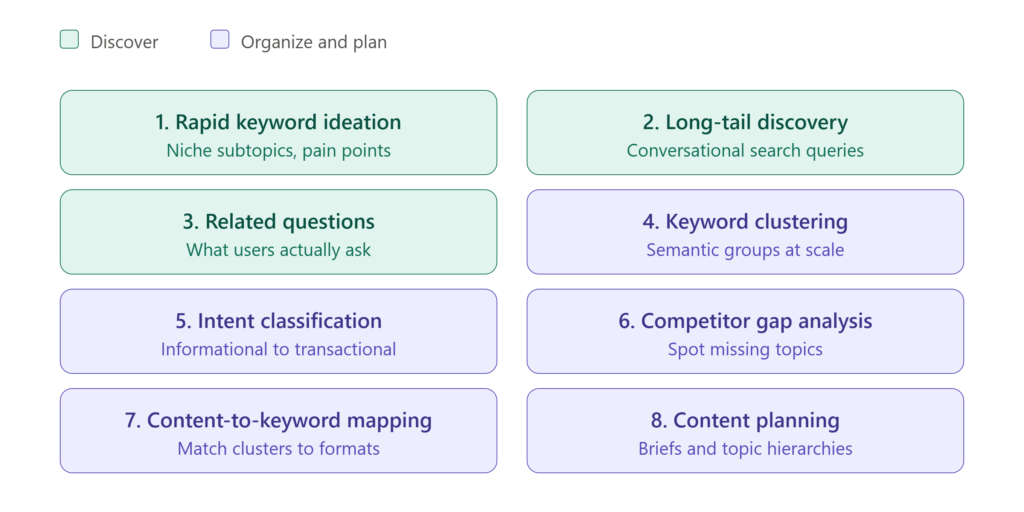
Here are some of the most useful applications:
- Rapid Keyword Ideation: AI can generate niche subtopics, keyword variations, and audience pain points.
- Long-Tail Keyword Discovery: AI can create specific, conversational search queries based on real-world problems.
- Related Questions: AI can generate questions users may ask around a topic.
- Keyword Clustering: AI can organize hundreds of related terms into logical semantic groups.
- Search Intent Classification: AI can initially classify keywords as informational, navigational, commercial, or transactional.
- Competitor Topic-Gap Analysis: AI can analyze competitor outlines and identify potentially missing topics.
- Content-to-Keyword Mapping: AI can help match keyword clusters with suitable content formats.
- Content Planning: AI can transform keyword clusters into article ideas, content briefs, and topic hierarchies.
If you are new to using artificial intelligence for SEO, start with our beginner-friendly guide on How to Use AI for SEO, which explains how AI can support broader SEO workflows.
AI Keyword Research vs. Traditional Keyword Research
To understand where AI adds the most value, compare the two approaches:
| Feature / Metric | Traditional Keyword Research | AI-Assisted Keyword Research |
|---|---|---|
| Ideation Speed | Slow; manual brainstorming and seed expansion | Fast; generates many ideas quickly |
| Search Volume Data | Available through SEO databases | Requires external validation |
| Search Intent Analysis | Manual SERP review | Fast initial classification |
| Keyword Clustering | Manual spreadsheet sorting or dedicated tools | Fast semantic grouping |
| Long-Tail Discovery | Dependent on database coverage | Extensive conversational expansion |
| Human Involvement | High execution effort | Strategic review and validation |
| Validation Requirement | Built into the research process | Essential before final keyword selection |
AI should therefore complement—not replace—traditional SEO research.
How to Use AI for Keyword Research: Step-by-Step
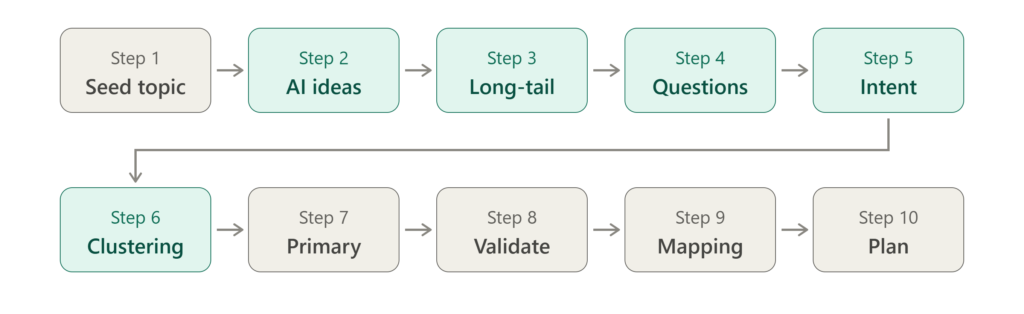
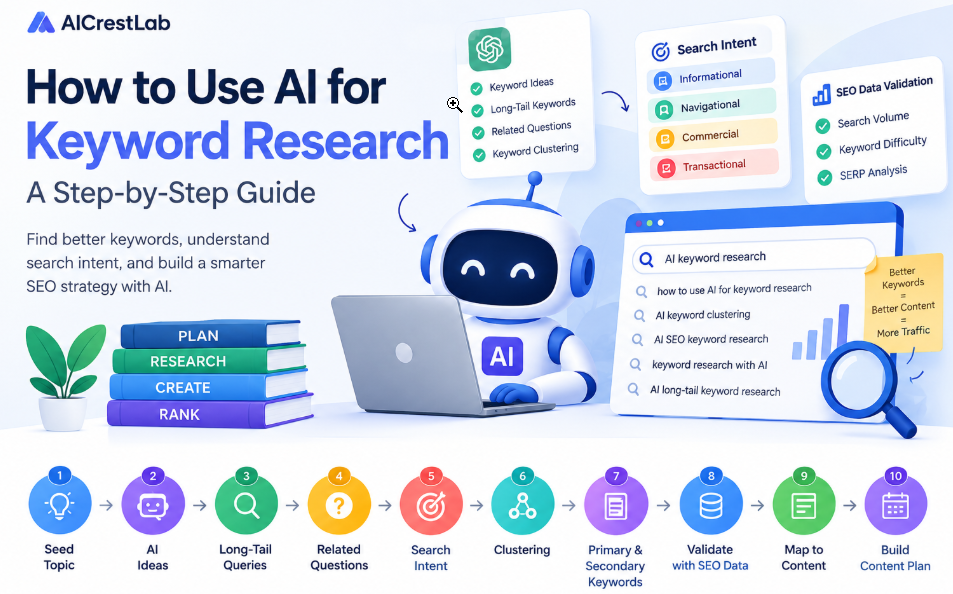
A reliable AI keyword research workflow can be divided into ten practical stages:
Seed Topic → AI Ideas → Long-Tail Queries → Related Questions → Search Intent → Keyword Clustering → Primary Keyword → Data Validation → Content Mapping → Content Plan
Step 1: Start With a Seed Topic
A seed topic or seed keyword is a broad term representing your core business, product, service, or niche.
Examples include:
cloud accounting softwarehome coffee brewingAI writing toolsB2B email marketing
Your seed topic gives the AI a starting point from which it can generate related concepts and search queries.
Before generating keywords, define your target audience. A keyword strategy for beginners will look very different from one designed for enterprise SEO professionals.
For example, if your website focuses on artificial intelligence, your seed topic might be AI SEO tools. From there, AI can expand the topic into keyword variations, questions, use cases, and related subtopics.
Step 2: Ask AI to Generate Keyword Ideas
Once you have your seed topic, ask your preferred AI assistant to generate keyword ideas across different subtopics and audience needs.
You can use platforms such as ChatGPT or Google Gemini for this initial brainstorming stage.
Instead of simply asking:
“Give me keywords about AI SEO.”
Use a more structured instruction:
“Act as an SEO strategist. Generate keyword opportunities related to AI SEO for beginners, small businesses, and marketing professionals. Separate the keywords by search intent and topic.”
The more context you provide, the more useful the output becomes.
Step 3: Find Long-Tail Keywords With AI
Long-tail keywords are specific search queries that usually contain several words and express a clearer user need.
For example:
Broad keyword:CRM software
More specific long-tail queries:
best CRM software for real estate agentsfree CRM software for small businessesCRM software with automated email sequences
AI is particularly useful for expanding a broad seed keyword into conversational variations.
However, remember that an AI-generated phrase does not automatically mean people search for it. Treat these suggestions as keyword candidates, not confirmed search opportunities.
Step 4: Discover Related Questions
Question-based searches can reveal important subtopics and content opportunities.
Ask AI to generate questions using modifiers such as:
- What
- How
- Why
- Can
- Which
- Is
For example, around AI keyword research:
- What is AI keyword research?
- How can AI help with keyword research?
- Can ChatGPT find low-competition keywords?
- Is AI keyword research accurate?
- Which AI tools are best for keyword clustering?
These questions can become FAQ entries, H2/H3 sections, supporting articles, or standalone content depending on their search intent.
Step 5: Analyze Search Intent
Search intent describes the reason behind a user’s search.
Understanding intent is essential because a keyword can have significant search demand but still be a poor target if your page does not satisfy what searchers actually want.
Google’s SEO Starter Guide emphasizes creating useful, well-organized content that serves users’ needs.
AI can help classify keyword lists into four major categories:
| Search Intent | What the User Wants | Example |
|---|---|---|
| Informational | Learn something | what is AI keyword research |
| Navigational | Find a specific website/page | Google Keyword Planner login |
| Commercial Investigation | Compare options before buying | best AI SEO tools |
| Transactional | Take an action or make a purchase | buy SEO software |
AI classification is useful as a first pass, but always check the actual Google SERP before committing to a keyword.
Step 6: Cluster Similar Keywords
Keyword clustering means grouping related search queries according to topic and intent.
Instead of creating a separate article for every minor keyword variation, you can group closely related queries into one comprehensive content asset.
For example:
| Cluster Topic | Intent | Example Keywords | Recommended Content |
|---|---|---|---|
| AI Keyword Research | Informational | AI keyword research, keyword research with AI, how to use AI for keyword research | Comprehensive guide |
| AI SEO Tools | Commercial | best AI SEO tools, AI SEO software, top AI SEO tools | Comparison/listicle |
| AI Keyword Clustering | Informational | AI keyword clustering, cluster keywords with AI | Tutorial |
| AI SEO Strategy | Informational | AI SEO strategy, AI SEO workflow | Guide |
Clustering helps prevent unnecessary duplicate pages and makes it easier to build a logical topic structure.
Step 7: Identify the Primary Keyword
After clustering your keywords, select one Primary Keyword for each content asset.
The remaining relevant phrases become Secondary Keywords.
For this article, for example:
Primary Keyword: AI keyword research
Secondary Keywords:
- how to use AI for keyword research
- AI for keyword research
- AI keyword research tools
- AI SEO keyword research
- keyword research with AI
- AI keyword clustering
- AI long-tail keyword research
- AI search intent analysis
When choosing the primary keyword, consider:
- Search intent alignment.
- Business relevance.
- Ranking difficulty.
- Search demand.
- Existing site authority.
- Potential to attract the right audience.
Do not choose a keyword simply because an AI model says it sounds popular.
Step 8: Validate AI-Generated Keywords
This is one of the most important stages of the entire process.
AI-generated keywords must be validated with real SEO data.
Generative AI can suggest plausible search phrases, but a standard AI model should not be treated as a source of accurate live search volume, Keyword Difficulty scores, CPC data, or current ranking positions.
Use real SEO data sources to validate the candidates.
Google Search Console
If your website already receives organic traffic, Google Search Console is one of the most useful sources for discovering queries your pages already appear for.
Use it to identify:
- Existing search queries
- Impressions
- Clicks
- Average position
- Click-through rate
For documentation and troubleshooting, use Google Search Console Help.
Google Keyword Planner
Google Keyword Planner can help validate keyword demand and discover additional keyword ideas.
Google also provides official documentation for using the tool in its Google Ads Keyword Planner Guide.
Third-Party SEO Platforms
Platforms such as Ahrefs, Semrush, and Moz can provide additional data for:
- Keyword Difficulty
- Search volume
- SERP competition
- Competitor rankings
- Backlink analysis
- Related keyword opportunities
The important principle is simple:
Let AI generate and organize ideas. Let real SEO data determine which ideas deserve to become targets.
Step 9: Map Keywords to Content
After validating your keyword clusters, map them to the appropriate content type.
Create a New Article
Use a new article when the keyword represents a distinct topic with its own search intent.
Example:
how to use AI for keyword research
could become a standalone guide.
Add a Section to an Existing Article
If a keyword is closely related to an existing page and does not require a separate resource, make it a section within that article.
Create a Product or Landing Page
Commercial and transactional keywords may be better suited to product pages or landing pages rather than informational blog posts.
Build Supporting Cluster Content
Smaller related topics can become supporting articles that link back to a larger pillar page.
For example:
Pillar: Complete Guide to AI SEO
→ How to Use AI for Keyword Research
→ AI SEO Content Optimization
→ Best AI SEO Tools
This structure creates a stronger topical relationship between your content assets.
Step 10: Build a Keyword-Based Content Plan
Once the keywords have been validated and mapped, turn them into a practical content calendar.
For example:
Pillar Page: Complete Guide to AI SEO
- How to Use AI for Keyword Research
- AI SEO Content Optimization
- Best AI SEO Tools
You can then use internal links between these related resources where the context naturally supports them.
This approach helps transform keyword research from a spreadsheet exercise into an organized SEO content strategy.
Practical Example: Expanding a Seed Topic
Consider the seed keyword:
AI SEO tools
An AI assistant might generate:
Primary Keyword Candidates
- AI SEO tools
- best AI SEO tools
- AI SEO software
Secondary Keywords
- AI tools for SEO
- AI SEO optimization tools
- AI tools for search optimization
- AI SEO software for beginners
Long-Tail Queries
- free AI SEO tools for small businesses
- best AI keyword research tools for beginners
- AI SEO tools for content optimization
Related Questions
- What is the best AI tool for keyword research?
- Can AI SEO tools replace manual SEO?
- Which AI SEO tool is best for beginners?
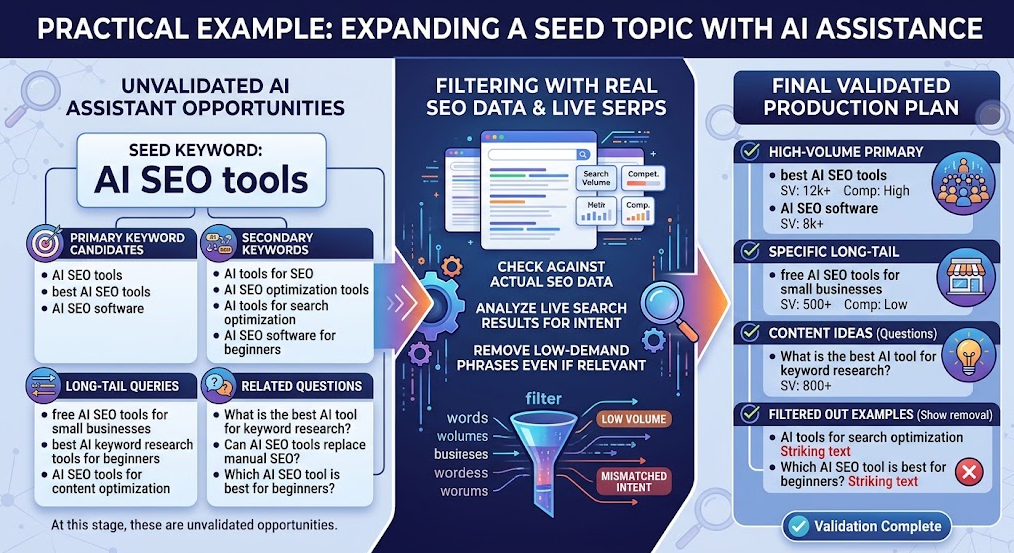
At this stage, these are unvalidated opportunities.
The next step is to check them against actual SEO data and live SERPs.
If a keyword has little or no measurable demand, remove it from the production plan even if the phrase sounds highly relevant.
For a broader overview of software in this category, see our guide to the Best AI SEO Tools.
8 Copy-and-Paste AI Keyword Research Prompts
The following prompts can be adapted for ChatGPT, Gemini, Claude, or another AI assistant.
Prompt 1: Keyword Idea Generation
Act as an expert SEO strategist.

Generate 20 relevant keyword ideas related to the seed topic "[INSERT SEED TOPIC]".

Organize them into 4 distinct sub-categories based on user pain points.

Focus on actionable topics relevant to [INSERT TARGET AUDIENCE].

Exclude generic broad terms and avoid irrelevant keyword variations.

For each keyword, provide:
- Keyword
- Search intent
- Suggested content angle
Prompt 2: Long-Tail Keyword Discovery
I am creating content around "[INSERT TOPIC]".

Act as a search intent expert.

Generate 15 specific long-tail search queries containing 3 or more words.

Focus on solution-oriented searches related to this topic.

Include:
- Beginner queries
- Problem-solving queries
- Comparison queries
- Commercial investigation queries
- Highly specific niche queries

Do not provide search volume estimates.
Prompt 3: Search Intent Classification
Classify the following keyword list into: 1. Informational 2. Navigational 3. Commercial Investigation 4. Transactional Return the results in a table with: Keyword | Search Intent | Reason Keywords: [PASTE KEYWORD LIST HERE] If the intent is ambiguous, explain why instead of guessing.Prompt 4: Keyword Clustering
Act as an SEO content architect.

Group the following keywords into semantic clusters based on topic and search intent.

For each cluster provide:

- Cluster name
- Primary keyword
- Secondary keywords
- Search intent
- Recommended content type
- Potential article title

Keyword list:
[PASTE KEYWORD LIST HERE]
Prompt 5: Finding Related Questions
Act as an SEO researcher.

Generate 15 useful question queries related to "[INSERT SEED TOPIC]".

Group them into:

- Informational: What / Why
- Tactical: How
- Evaluation: Which / Is / Can

Focus on questions that could realistically help a content strategist identify useful subtopics.

Do not invent search volume data.
Prompt 6: Competitor Topic-Gap Brainstorming
Here is an outline of a competitor article about "[INSERT TOPIC]":

[PASTE COMPETITOR OUTLINE]

Analyze the outline and identify:

- 5 potentially missing subtopics
- Secondary keyword opportunities
- User questions not addressed
- Content angles that could provide additional value

Do not simply copy the competitor's structure.

Suggest opportunities for creating a more useful and differentiated article.
Prompt 7: Selecting Primary and Secondary Keywords
I am targeting a main topic around "[INSERT TOPIC]".

Here is my candidate keyword list:

[PASTE KEYWORD LIST]

Select:

1. One primary keyword
2. Secondary keywords
3. Supporting long-tail keywords

Base your recommendation on:
- Search intent
- Topic relevance
- Business relevance
- Content scope

Do not claim specific search volume or keyword difficulty unless I provide verified data.
Prompt 8: Creating a Keyword-to-Content Map
Take the following keyword clusters and create a content mapping table.

Include:

1. Target keyword cluster
2. Primary keyword
3. Search intent
4. Recommended content format
5. Recommended H1 title
6. Important H2 sections
7. Suggested internal linking opportunities

Clusters:
[PASTE YOUR CLUSTERED KEYWORDS HERE]
Common AI Keyword Research Mistakes to Avoid
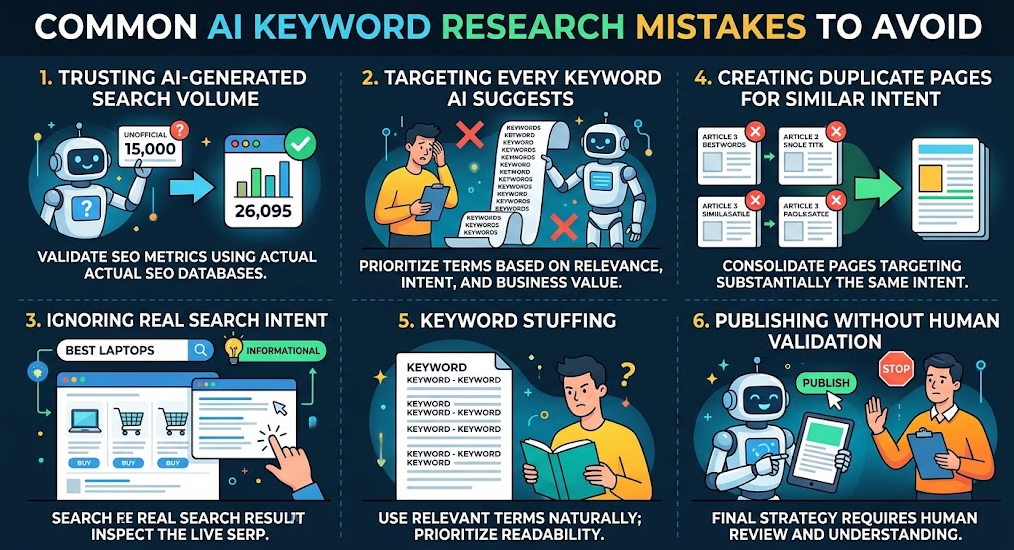
AI can dramatically accelerate keyword research, but several mistakes can undermine the entire strategy.
1. Trusting AI-Generated Search Volume
AI should not be treated as a reliable source for current monthly search volume.
Validate numerical SEO metrics using actual SEO databases.
2. Targeting Every Keyword AI Suggests
Generating hundreds of keywords does not mean you need hundreds of pages.
Prioritize terms based on relevance, intent, demand, competition, and business value.
3. Ignoring Real Search Intent
A keyword may look informational but produce mostly product pages in Google.
Always inspect the current SERP before deciding what type of content to create.
4. Creating Duplicate Pages for Similar Intent
Do not create separate articles simply because two keywords are worded slightly differently.
If the search intent is substantially the same, consider targeting both within one stronger page.
5. Keyword Stuffing
Do not force every AI-generated keyword into your article.
Use relevant terms naturally and prioritize readability.
6. Publishing Without Human Validation
AI can accelerate the research process, but the final strategy should be reviewed by a human who understands the audience, business, and competitive landscape.
AI Keyword Research Tools: Overview of the Tool Stack
A practical AI keyword research stack combines AI assistants with dedicated SEO data platforms.
1. General AI Assistants
Examples include:
- ChatGPT
- Google Gemini
- Claude
These tools are useful for:
- Keyword brainstorming
- Long-tail expansion
- Search intent classification
- Keyword clustering
- Content mapping
For example, you can use our ChatGPT Review and Google Gemini Review to understand the capabilities of two popular AI assistants.
2. SEO Data and Validation Platforms
Use tools such as:
- Google Search Console
- Google Keyword Planner
- Ahrefs
- Semrush
- Moz
These platforms provide the data needed to validate AI-generated ideas.
3. Keyword Clustering and Content Optimization Tools
Platforms such as Surfer SEO, Clearscope, and MarketMuse can help analyze topical coverage and organize content opportunities.
For a broader comparison of AI-powered SEO software, see our guide to the Best AI SEO Tools.
4. Automation and Workflow Tools
Once your keyword research process is established, automation tools can reduce repetitive tasks.
For broader workflow automation, see our guide to AI Automation and our recommendations for Best AI Productivity Tools.
What AI Can and Cannot Do in Keyword Research
Understanding AI’s limitations helps you use it more effectively.
| Task | AI Can Help With | Human / Data Tool Needed |
|---|---|---|
| Keyword brainstorming | Generate semantic ideas | Business relevance review |
| Long-tail discovery | Generate conversational queries | Search-demand validation |
| Search volume | ❌ Not reliably | ✅ SEO data tools |
| Keyword Difficulty | ❌ Not reliably | ✅ SEO databases |
| Keyword clustering | ✅ Yes | Human review |
| Search intent tagging | ✅ Initial classification | Live SERP verification |
| Content mapping | ✅ Draft recommendations | Strategic prioritization |
| Competitor analysis | Outline and topic analysis | Live SERP and competitor data |
The best workflow is therefore a combination of AI reasoning + verified SEO data + human strategy.
How Beginners Can Start
If you are completely new to AI keyword research, start with this simplified workflow:
1. Pick a Seed Topic → 2. Prompt AI → 3. Group Keywords → 4. Validate Data → 5. Select Primary Keyword → 6. Build Content
Pick One Seed Topic
Choose a core topic relevant to your website.
Prompt AI for Ideas
Use the keyword-generation prompts above to expand the topic.
Group and Tag Intent
Cluster similar keywords and classify their search intent.
Validate the Data
Use Google Search Console, Google Keyword Planner, or an SEO platform to verify the opportunities.
Select Your Primary Keyword
Choose the keyword that best balances relevance, intent, demand, competition, and business value.
Build the Content
Create your article around the primary keyword while naturally incorporating relevant secondary terms and questions.
For the next stage—turning keyword research into a stronger existing article—see our guide on AI SEO Content Optimization.
Frequently Asked Questions
What is AI keyword research?
AI keyword research is the use of artificial intelligence to accelerate keyword ideation, long-tail discovery, search-intent classification, keyword clustering, and content mapping.
Can AI do keyword research automatically?
AI can automate many parts of the research process, including brainstorming, clustering, and initial intent classification. However, complete keyword research still requires verified SEO data and human strategic judgment.
Is AI keyword research accurate?
AI is generally useful for semantic tasks such as keyword expansion and categorization. It should not be treated as a reliable source for live search volume, Keyword Difficulty, CPC, or current ranking positions unless those figures come from a connected and verified data source.
Can ChatGPT find keywords for my website?
Yes. ChatGPT can generate topic ideas, long-tail queries, related questions, and keyword clusters. You should then validate those suggestions against real SEO data.
Can Gemini be used for keyword research?
Yes. Google Gemini can assist with keyword ideation, query expansion, search-intent analysis, topic clustering, and content planning. As with other generative AI tools, its keyword suggestions should be validated before being used as final SEO targets.
How do I find long-tail keywords with AI?
Give the AI a specific seed topic, target audience, and problem to solve. Ask it to generate detailed, multi-word search queries that reflect different stages of the user’s journey.
Then validate the most promising suggestions using real search data.
Can AI tell me real keyword search volume?
Standard generative AI models should not be relied upon for accurate live keyword search volume.
Use Google Keyword Planner, Google Search Console, Ahrefs, Semrush, or another reliable SEO data source to verify demand.
What is AI keyword clustering?
AI keyword clustering is the process of grouping related search queries according to their semantic relationship and search intent.
This helps you determine which keywords can be targeted by one comprehensive page and which deserve separate content.
Should I trust AI-generated keywords?
Use AI-generated keywords as ideas and research candidates, not as verified SEO facts.
Before targeting a keyword, check its relevance, search intent, actual demand, SERP competition, and business value.
Internal Linking Strategy for AICrestLab
This article should connect naturally with other relevant AICrestLab resources.
Contextual Internal Links
When introducing the broader role of AI in SEO, link to How to Use AI for SEO.
When discussing content planning and what happens after keyword research, link to AI SEO Content Optimization.
When discussing AI-powered SEO software, link to Best AI SEO Tools.
When discussing individual AI assistants, use contextual links to the ChatGPT Review and Google Gemini Review.
When discussing workflow automation, link to AI Automation.
For productivity-related workflow improvements, link to Best AI Productivity Tools.
These links should remain within relevant paragraphs rather than being placed as an unrelated list of links at the bottom of the page.
External Authoritative Sources
Use authoritative Google resources where the article discusses search guidelines and SEO data.
For Google’s SEO guidance, refer readers to the Google Search Central SEO Starter Guide.
For website performance data, use Google Search Console and its official help documentation.
For keyword discovery and search-demand research, use Google Keyword Planner and Google’s official Keyword Planner documentation.
These external links provide readers with primary-source resources rather than relying entirely on third-party SEO blogs.
Conclusion
AI keyword research is not about asking an AI model to produce a list of keywords and publishing content around every suggestion.
The real advantage comes from using AI to accelerate the parts of SEO research that require semantic reasoning: brainstorming, long-tail expansion, question discovery, intent classification, clustering, and content mapping.
The critical second half of the process is validation.
Use real SEO data to determine whether a keyword has measurable demand, whether the competition is realistic, and whether the SERP matches your intended content format.
The most effective workflow combines three components:
AI → Semantic Research
SEO Data → Validation
Human Expertise → Strategy
When these three work together, AI can turn keyword research from a time-consuming spreadsheet exercise into a faster, more organized, and more actionable SEO workflow.
Next Step for Beginners: Choose one seed topic from your website, generate keyword ideas with AI, cluster them by intent, validate the strongest candidates using real SEO data, and turn the final cluster into your next content brief.
Also Read: 15 Best AI Marketing Tools in 2026: Tested & Compared

Hammad Ali is an AI and technology enthusiast who writes about Generative AI, AI tools, automation, and emerging technologies in simple, practical language.