Publishing new articles consistently can help grow a website, but creating more content is not always the fastest way to increase organic traffic.
Many websites already have dozens or hundreds of published pages that receive search impressions but fail to generate enough clicks, rankings, or conversions. These pages may be suffering from outdated information, weak headings, incomplete topic coverage, poor readability, mismatched search intent, or weak internal linking.
This is where AI SEO content optimization can make a significant difference.
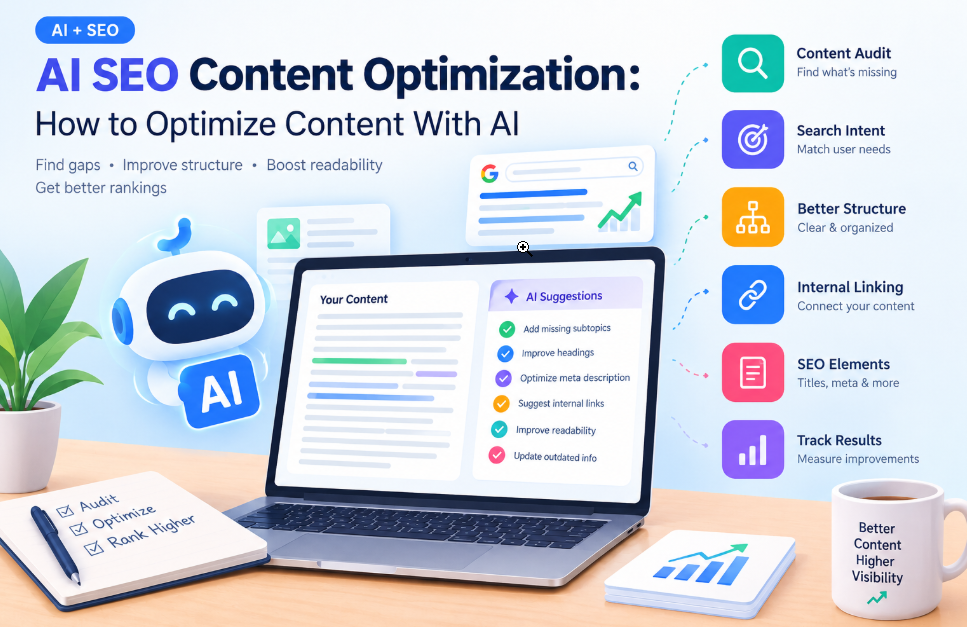
Instead of using artificial intelligence to produce hundreds of articles automatically, you can use AI to analyze and improve content that already exists on your website. AI can help identify content gaps, evaluate structure, improve readability, suggest internal links, and find areas that may need updating.
The important distinction is that AI should support your SEO workflow rather than replace human judgment.
In this guide, you will learn how to use AI to optimize existing SEO content, which parts of an article AI can improve, how to perform an AI content audit, which tools can help, and how to build a practical optimization workflow.
What Is AI SEO Content Optimization?
AI SEO content optimization is the use of artificial intelligence to analyze and improve existing website content so that it better satisfies search intent, covers important topics, remains readable, and follows sound SEO practices.
It is different from simply asking AI to write a new article.
There are three closely related approaches:
| Approach | Main Focus | Primary Goal |
|---|---|---|
| AI Content Creation | Producing new content from scratch | Expand website coverage |
| Traditional Content Optimization | Manually reviewing and improving existing pages | Improve rankings and user experience |
| AI-Assisted Content Optimization | Using AI to accelerate audits, research, editing, and analysis | Improve existing content more efficiently |
AI is particularly useful for processing large amounts of information. It can quickly identify repeated ideas, unclear sections, missing subtopics, weak headings, potential internal links, and areas that could be easier to read.
However, AI recommendations should not be treated as automatic SEO rules.
Human review is still necessary to verify facts, evaluate search intent, add firsthand experience, preserve brand voice, and decide which recommendations actually make sense.
Key takeaway: AI can make content optimization faster and more systematic, but the final SEO and editorial decisions should remain with a human.
How Does AI Content Optimization Work?
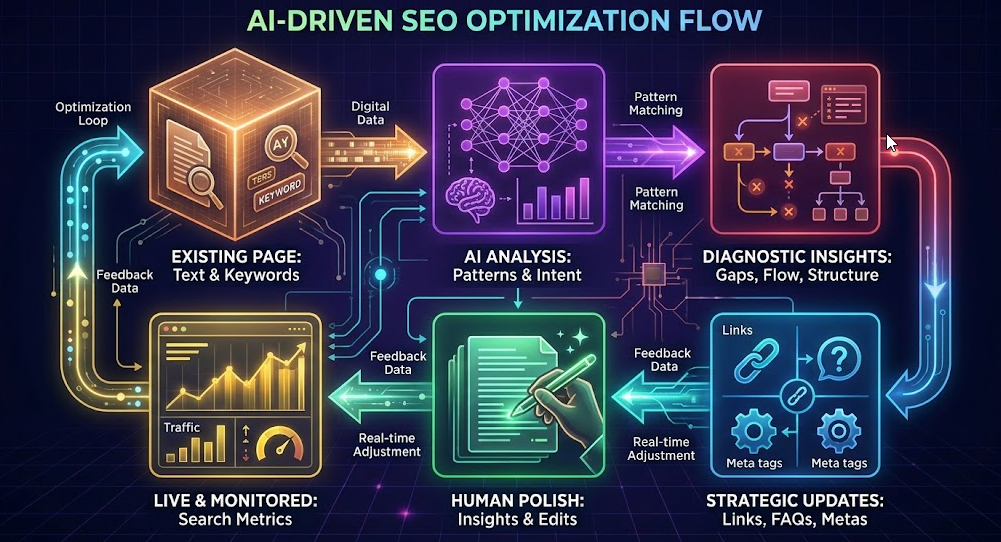
AI content optimization usually starts with an existing article and a clearly defined search goal.
You provide the AI with information such as the current article, target keyword, audience, search intent, and when available performance data from tools such as Google Search Console.
The AI can then evaluate different parts of the page and organize its recommendations.
A typical AI-assisted workflow looks like this:
- Select an existing page with ranking or traffic potential.
- Audit the content for clarity, depth, structure, and repetition.
- Evaluate search intent and determine whether the page answers the right question.
- Identify content gaps and missing user questions.
- Improve the heading structure and organization.
- Review on-page SEO elements such as titles, descriptions, and alt text.
- Find internal linking opportunities across your website.
- Add original human value and verify important information.
- Publish the update and monitor performance.
The goal is not to change every sentence simply because an AI tool recommends it. The goal is to identify changes that genuinely make the page more useful.
What Can AI Optimize in an SEO Article?

AI can assist with many parts of an existing SEO article. The most useful applications include the following.
1. Search Intent Alignment
One of the most important parts of SEO is understanding what a person actually wants when they search for something.
AI can analyze your article and determine whether its format and information match the likely intent behind a query.
For example, someone searching for “best project management software” may expect a comparison of tools, features, pricing, pros and cons, and recommendations.
If your article spends most of its space explaining what project management means, AI can identify the mismatch and recommend moving toward a comparison-focused structure.
AI can help classify search intent into broad categories such as:
- Informational
- Commercial investigation
- Transactional
- Navigational
However, search intent should also be evaluated by examining the actual search results. AI analysis should support that research rather than replace it.
2. Content Gap Analysis
A content gap occurs when an article fails to answer an important part of the user’s question.
AI can compare your existing article with the topics, questions, and concepts commonly associated with the subject and highlight areas that deserve attention.
For example, an article about remote team management might cover communication but ignore:
- Employee onboarding
- Time-zone coordination
- Productivity measurement
- Remote collaboration tools
- Security considerations
Adding relevant missing information can make the article more comprehensive without simply making it longer.
3. Headings and Content Structure
A good heading structure makes long articles easier to navigate.
AI can review your H1, H2, and H3 headings and identify:
- Vague headings
- Repeated sections
- Poor topic order
- Missing subtopics
- Sections that should be combined
- Sections that deserve their own heading
Instead of headings such as “Overview” or “More Details,” a more descriptive structure might use headings such as “Key Features to Look For in Project Management Software.”
The objective is to make the structure meaningful to both readers and search engines.
4. Semantic Keywords and Topic Coverage
Modern SEO is not simply about repeating one keyword throughout an article.
A page should naturally discuss related concepts and entities that help explain the subject completely.
AI can identify related terminology and concepts that may be missing from an article.
For example, an article about SEO content optimization may naturally involve concepts such as:
- Search intent
- Content gaps
- Internal linking
- Meta descriptions
- Semantic relevance
- Readability
- Content freshness
- Search performance
These terms should only be added when they genuinely improve the article.
Do not insert keywords simply because an AI tool recommends them.
5. Readability and Phrasing
AI can also work as an editorial assistant.
It can identify:
- Very long sentences
- Dense paragraphs
- Repetitive explanations
- Awkward transitions
- Unnecessary filler
- Passive or unclear phrasing
The objective is not to make every sentence extremely short. Instead, the goal is to make the article easier to understand without removing useful information.
6. SEO Titles and Meta Descriptions
AI can generate multiple versions of SEO titles and meta descriptions for testing and editorial review.
For example, you can ask AI to create several descriptions that:
- Clearly explain what the page offers
- Include the primary topic naturally
- Encourage clicks
- Avoid exaggerated claims
- Stay within a practical length
The final version should always accurately represent the page.
7. Internal Linking Opportunities
Internal linking is another area where AI can save considerable time.
When you have a large website, manually identifying every relevant connection between articles can become difficult.
AI can analyze an article and suggest places where links to related pages would make sense.
For example, AICrestLab can connect this article with related resources such as:
The important part is context. Internal links should help the reader continue learning rather than being inserted only for SEO purposes.
8. Image Alt Text
AI can help create descriptive alt text when it has enough context about an image.
Good alt text should describe the meaningful content of the image rather than unnecessarily repeating keywords.
For example, if an article contains a screenshot showing an AI content audit, the alt text should describe what the image actually shows.
9. FAQ Development
AI can help identify questions that readers may have after reading an article.
These questions can become useful FAQ sections when they genuinely add value.
Instead of creating FAQs simply to add more keywords, focus on questions that address genuine information gaps.
10. Identifying Outdated Information
Older content can contain outdated:
- Statistics
- Product features
- Pricing
- Software versions
- Dates
- Terminology
- External references
AI can scan an article and flag potentially outdated sections.
However, AI should only identify what needs checking. You should verify current information using authoritative sources before publishing an update.
AI Content Audit: A Practical Example
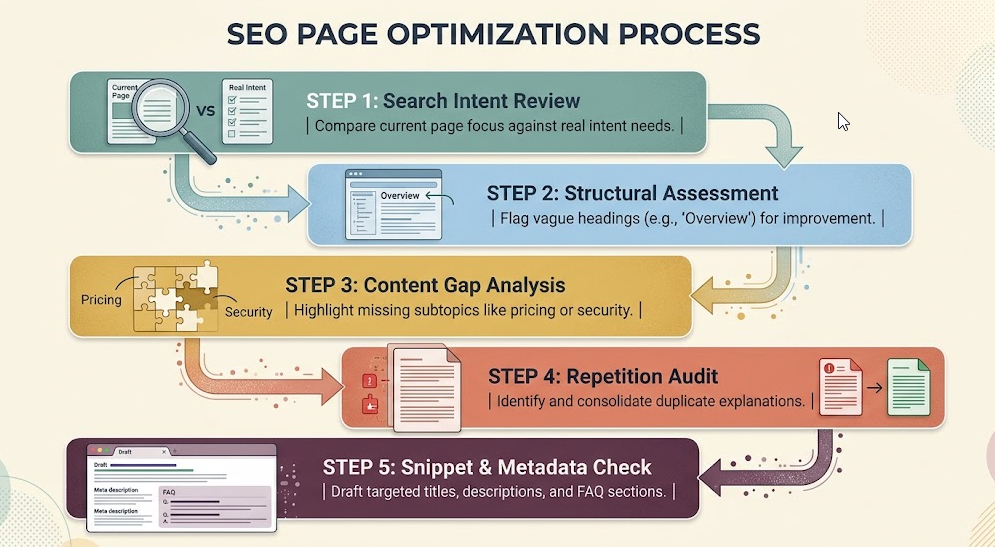
Consider a technology website with an article targeting the query “best project management software.”
The page receives impressions but remains around page two or three of search results.
The article is two years old and contains long paragraphs, outdated information, and mostly introductory explanations.
An AI-assisted audit could reveal several problems.
Step 1: Analyze Search Intent
First, ask AI to evaluate whether the article satisfies the intent behind the target query.
If the current search results are dominated by comparison articles, but your page primarily provides a basic definition, there is an obvious intent mismatch.
Step 2: Review the Structure
Next, ask AI to evaluate the article’s headings.
It may identify vague headings such as:
- Overview
- Details
- Final Thoughts
These can be replaced with more descriptive sections that tell readers exactly what they will learn.
Step 3: Find Missing Topics
AI can then identify potentially important comparison criteria such as:
- Pricing
- Team size
- Mobile applications
- Integrations
- Security
- Collaboration features
These recommendations should be checked against current search results and reliable sources before being added.
Step 4: Find Repetition
AI can identify sections that explain the same concept multiple times.
Instead of keeping three similar paragraphs, you can consolidate them into one stronger explanation.
Step 5: Improve Metadata
Finally, AI can generate potential SEO titles and meta descriptions for editorial review.
This provides several options without requiring the editor to write every variation manually.
Important: AI language models should not be treated as sources of live search volume, ranking positions, or CTR data unless they are connected to a reliable data source.
How to Use AI to Improve an Existing Blog Post
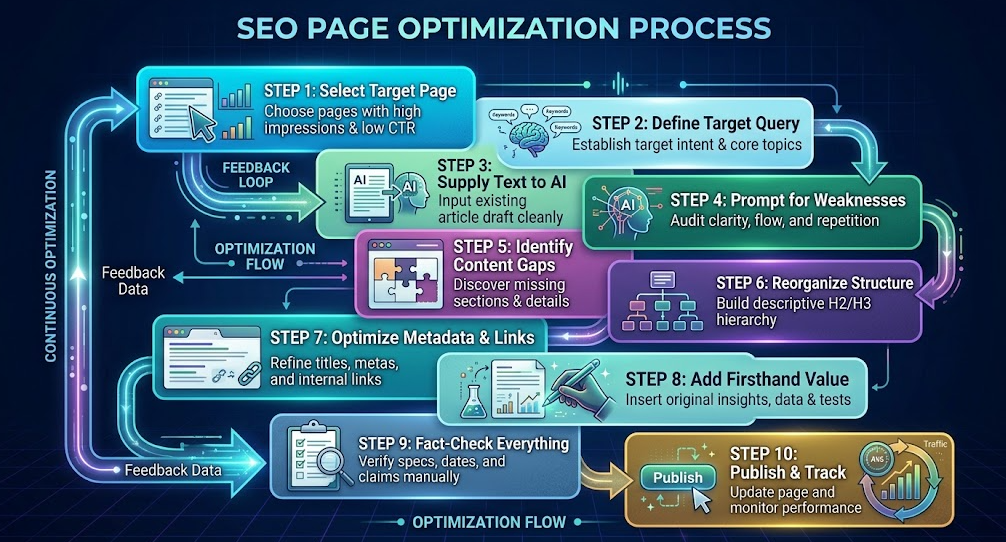
A structured process helps prevent unnecessary rewriting.
Step 1: Find a Page Worth Updating
Start with an existing page that already has some search visibility.
Google Search Console can help you identify pages that receive impressions but have relatively few clicks or pages ranking around positions 8–25.
These pages may have room for improvement.
Step 2: Define the Target Query
Choose the main search query the page should serve.
Then determine the likely search intent.
Ask:
- What does the searcher actually want?
- What format do the current search results favor?
- Is the user looking for information, comparison, instructions, or a product?
Step 3: Give AI Enough Context
Provide the AI with:
- Existing article
- Target keyword
- Search intent
- Target audience
- Website niche
- Relevant performance data
- Editorial guidelines
The more useful context you provide, the more relevant the recommendations are likely to be.
Step 4: Audit Weak Sections
Ask AI to identify:
- Unnecessary filler
- Repetition
- Confusing explanations
- Weak transitions
- Missing information
- Sections that do not support the search intent
Do not ask AI to rewrite the entire article immediately.
First understand what needs improvement.
Step 5: Identify Content Gaps
Ask the AI to list important questions, concepts, and subtopics that the article currently does not cover.
Then manually decide which gaps are genuinely relevant.
Step 6: Improve the Structure
Reorganize the article into a logical sequence.
Use:
- Clear H2 headings
- Descriptive H3 sections
- Bullet points
- Tables
- Short paragraphs
- Examples
This improves both readability and navigation.
Step 7: Optimize Metadata and Links
Use AI to generate potential:
- SEO titles
- Meta descriptions
- Image alt text
- Internal anchor text
- FAQ questions
Review every suggestion before publishing.
Step 8: Add Original Value
This is one of the most important steps.
AI can analyze existing information, but it cannot replace your own experience.
Add:
- Original examples
- Screenshots
- Testing results
- Personal observations
- Expert commentary
- Original data
- Unique recommendations
These elements can make an updated article more useful than simply rewriting competing pages.
Step 9: Fact-Check Everything
Verify important information before publishing.
Pay particular attention to:
- Statistics
- Pricing
- Product features
- Software capabilities
- Dates
- Technical instructions
- External references
For technical SEO information, use authoritative documentation such as Google Search Central.
Step 10: Publish and Monitor
Once the update is complete, publish the revised article and monitor its performance.
Track metrics such as:
- Impressions
- Clicks
- CTR
- Average position
- Organic traffic
- Engagement
Do not judge the success of an update based on a few days of data. Give the page enough time to establish a meaningful trend.
Example AI Prompt for Content Optimization
You can use a structured prompt like this when optimizing an existing article:
Act as an experienced SEO content strategist and editorial auditor. Analyze the article I provide for search intent alignment, topical coverage, content gaps, readability, heading structure, internal linking opportunities, outdated information, and on-page SEO.
Do not rewrite the entire article immediately. First identify the problems and explain why each issue matters. Separate recommendations into critical, useful, and optional changes.
Do not invent statistics, search volume, rankings, product features, or facts. If something requires external verification, clearly mark it as requiring verification.
After the audit, provide an improved article structure and specific recommendations for sections that should be rewritten, expanded, combined, or removed.
Preserve the original author’s expertise and voice. Do not use keyword stuffing or unnatural SEO language. Focus on satisfying search intent and creating genuinely useful content.
AI Content Optimization vs. AI Content Generation
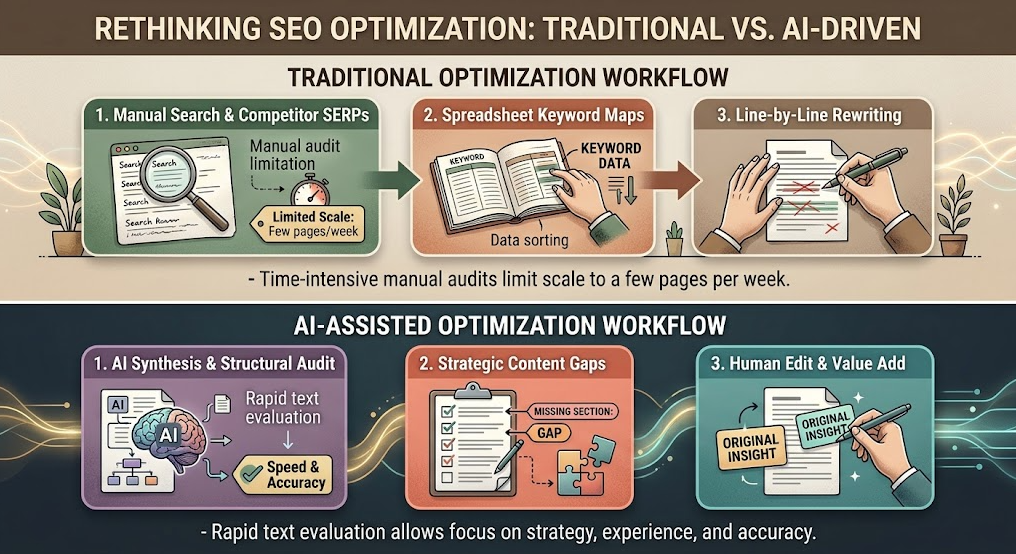
AI content generation and AI SEO content optimization may sound similar, but they solve different problems.
| Feature | AI Content Generation | AI SEO Content Optimization |
|---|---|---|
| Main Purpose | Create new content | Improve existing content |
| Starting Point | Prompt, topic, or keyword | Existing article or page |
| Typical Output | Initial draft | Audit, recommendations, revisions |
| SEO Objective | Expand topic coverage | Improve existing search performance |
| Human Role | Heavy editing and fact-checking | Strategic review and validation |
| Best Use | New articles and content ideas | Content refreshes and ranking improvements |
AI generation can help you create a first draft, while AI optimization focuses on making an existing asset stronger.
For broader information about generative AI, see our guide to Generative AI. For writing-focused tools, you can also explore our guide to the Best AI Writing Tools.
AI Content Optimization vs. Traditional Optimization
Content optimization existed long before generative AI.
The major difference is the amount of manual analysis involved.
Traditional Content Optimization
An SEO professional might manually:
- Open competing search results.
- Record their heading structures.
- Compare topics and subtopics.
- Review the existing article.
- Identify missing information.
- Rewrite weak sections.
- Create metadata.
- Find internal linking opportunities.
This process can be effective, but it becomes increasingly time-consuming as the website grows.
AI-Assisted Content Optimization
AI can accelerate many of these steps.
For example, it can quickly:
- Summarize competing content structures
- Identify repeated ideas
- Flag missing topics
- Suggest heading improvements
- Generate metadata variations
- Find potential internal linking opportunities
- Analyze large amounts of text
The human editor still decides which recommendations should actually be implemented.
AI provides speed; the SEO strategist provides judgment.
AI SEO Content Optimization Workflow
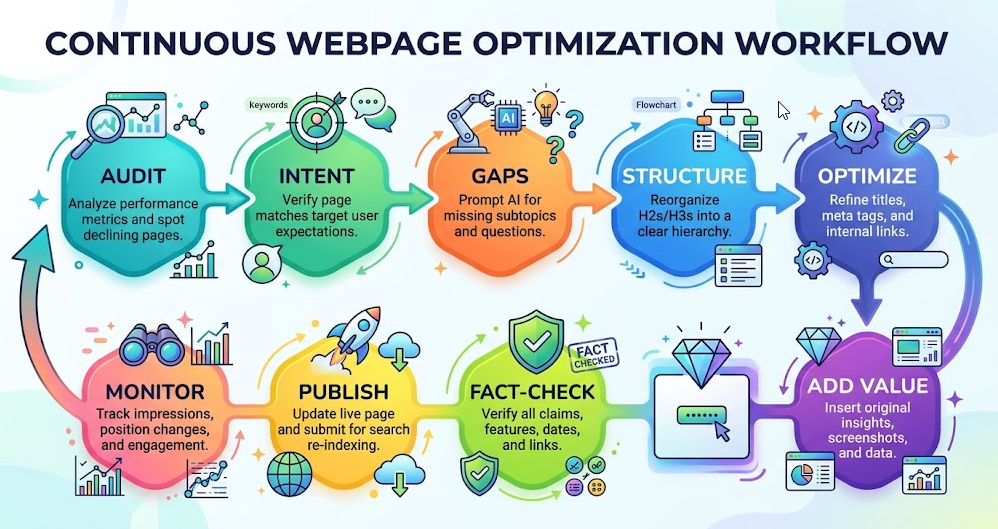
A simple optimization pipeline can be represented as:
Audit → Search Intent → Gap Analysis → Structure → On-Page Optimization → Original Value → Fact-Check → Publish → Monitor
The process works best when each stage has a clear purpose.
For example, there is little value in optimizing meta descriptions if the page itself does not satisfy the user’s search intent.
How AI Can Help Content That Is Not Ranking
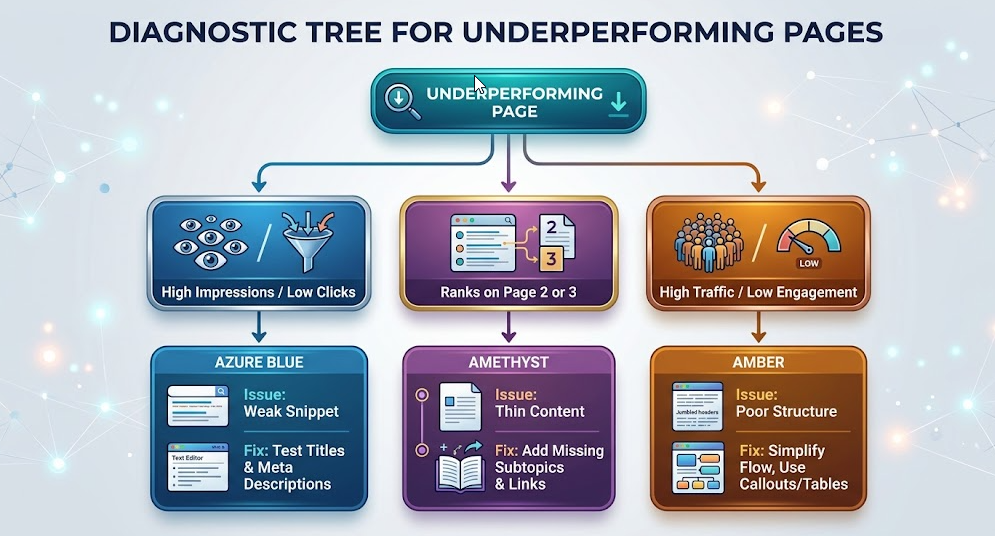
Different SEO problems require different solutions.
High Impressions but Low Clicks
If a page receives many impressions but few clicks, the problem may involve the search snippet or the alignment between the title and what users expect.
AI can help generate alternative title and meta description ideas.
However, changing the title alone will not solve a deeper content problem.
Page Stuck on Page Two or Three
A page ranking around positions 8–25 may already have relevance but could be missing important information, stronger structure, internal links, or a better match for search intent.
AI can help identify potential gaps and areas for improvement.
Visitors Leave Quickly
If users arrive but do not continue reading, review the page structure.
AI can identify:
- Long paragraphs
- Weak introductions
- Repetitive sections
- Difficult explanations
- Missing summaries
- Poor heading flow
You can then make the page easier to scan and understand.
Content Has Become Outdated
Older pages may lose relevance as products, statistics, technologies, and user expectations change.
AI can scan for dates, outdated terminology, old product information, and potentially stale sections.
Always verify the replacement information manually.
How to Use AI for Internal Linking
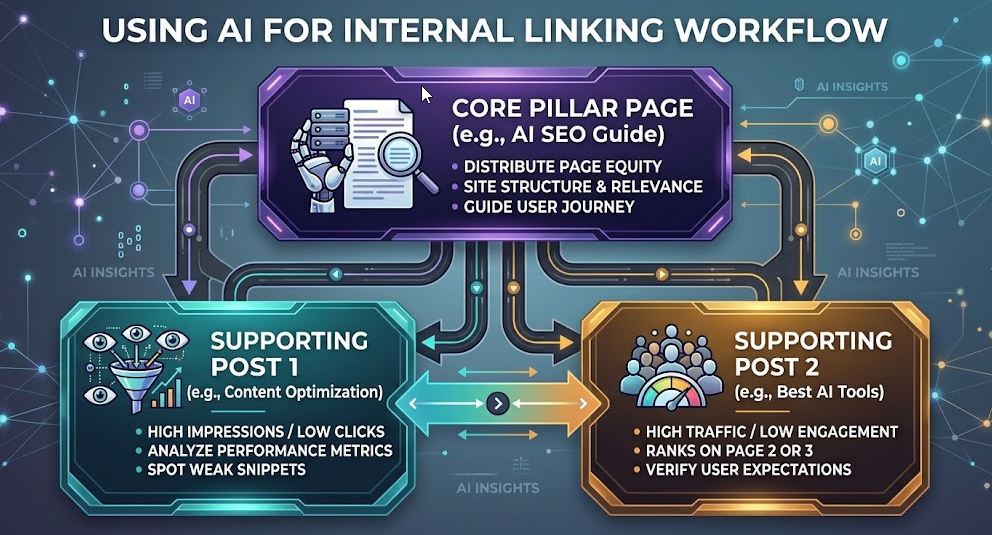
Internal linking can become difficult as your content library grows.
AI can help identify relationships between pages based on topic and context.
For AICrestLab, an article about AI SEO content optimization can naturally connect with:
The anchor text should describe the destination naturally.
For example:
Weak: Click here to learn more.
Better: Learn more about AI automation and how automated workflows can handle repetitive tasks.
Internal links should be useful to readers first and SEO-friendly second.
How to Use AI to Update Old Content
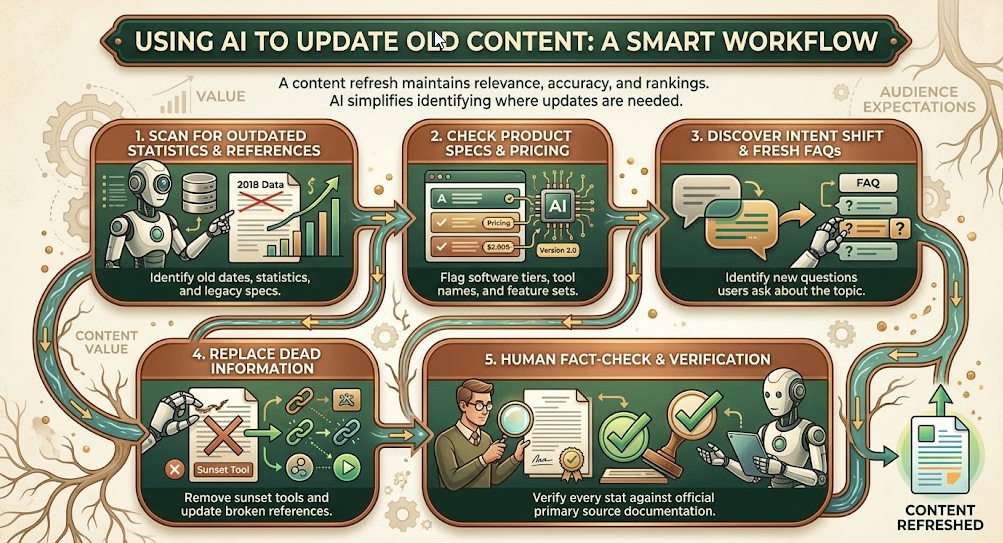
Content refreshes are one of the most practical applications of AI for SEO.
1. Find Old Dates and Statistics
Ask AI to identify every date, statistic, and time-sensitive statement in the article.
Then verify each item before changing it.
2. Check Product Information
For articles covering software or AI tools, review:
- Features
- Pricing
- Availability
- Integrations
- Screenshots
- Limitations
Use the official product website or documentation to verify current information.
3. Add New Questions
Search behavior changes over time.
AI can help brainstorm new questions that readers may now expect the article to answer.
4. Remove Outdated Concepts
Delete or replace references to:
- Discontinued products
- Deprecated features
- Old software versions
- Outdated SEO practices
5. Verify Against Primary Sources
Whenever possible, confirm technical and product information against primary sources.
For SEO guidance, Google Search Central is an important reference.
Benefits of AI SEO Content Optimization
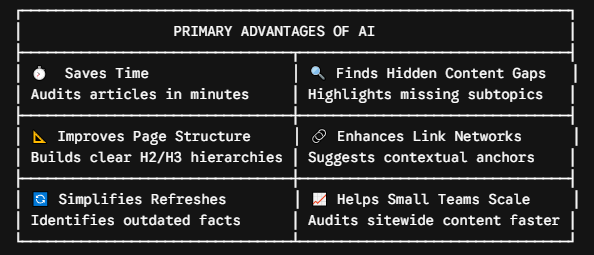
When used correctly, AI-assisted optimization can provide several advantages.
Saves Time
AI can perform initial content audits much faster than manually reviewing every paragraph.
Finds Content Gaps
It can highlight potentially important topics and questions that are easy to overlook.
Improves Content Structure
AI can help organize complicated articles into clearer sections and improve readability.
Makes Content Refreshes Easier
Instead of manually scanning hundreds of paragraphs for outdated information, AI can flag areas that deserve another look.
Supports Internal Linking
AI can identify potential relationships between articles across a large content library.
Helps Small Teams Scale
A small editorial team can use AI to perform more analysis without dramatically increasing manual workload.
Limitations of AI Content Optimization

AI is useful, but it has important limitations.
AI Can Be Wrong
AI models can generate incorrect facts, statistics, product details, and technical explanations.
Always verify important claims.
AI Does Not Automatically Have Live SEO Data
A standard AI model does not automatically know your current Google rankings, search volume, CTR, or backlink profile.
Those insights need to come from actual SEO and analytics data.
AI Does Not Have Your Experience
AI cannot personally test a software product or know what your customers experienced unless you provide that information.
Over-Optimization Can Hurt Quality
Adding every keyword suggested by an AI tool can make an article unnatural.
Use semantic terms where they genuinely improve the explanation.
AI Can Remove Your Brand Voice
If you allow AI to rewrite everything, your content can start sounding like every other AI-generated article.
Keep your own perspective and editorial style.
Search Intent Can Be Nuanced
AI may misunderstand the subtle differences between similar search queries.
Always compare its recommendations with the actual search results and your audience’s needs.
Common AI SEO Content Optimization Mistakes
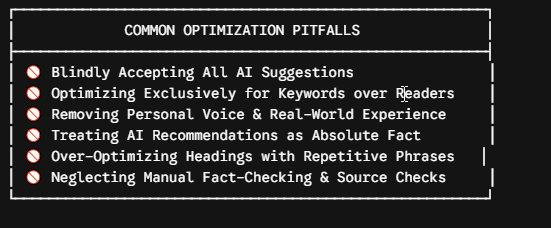
Avoid these mistakes when using AI to improve your content.
1. Publishing AI Rewrites Without Review
AI-generated changes should always be reviewed before publication.
2. Focusing Only on Keywords
SEO is not about forcing keywords into every paragraph.
Write for the reader first.
3. Removing Useful Information
An AI tool may identify a section as unnecessary even though it provides useful context.
Use editorial judgment before deleting anything.
4. Copying Competitor Structures
Competitor analysis should reveal opportunities, not become a blueprint for copying another website.
5. Increasing Word Count Without Purpose
A longer article is not automatically a better article.
Every section should serve the reader.
6. Trusting AI-Generated Statistics
Never publish a statistic simply because an AI model provided it.
Find and verify the original source.
Best AI Tools for Content Optimization
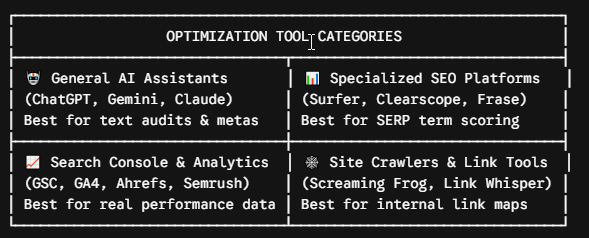
A practical AI SEO workflow can combine several categories of tools.
1. General-Purpose AI Assistants
Examples include:
- ChatGPT
- Google Gemini
- Claude
They can help with:
- Content audits
- Outlines
- Rewriting
- Metadata
- Internal linking ideas
- Readability reviews
2. Dedicated SEO Content Optimization Platforms
Examples include:
- Surfer SEO
- Clearscope
- Frase
- MarketMuse
These platforms are designed specifically for content optimization and can provide specialized recommendations around topical coverage and search performance.
3. SEO and Analytics Platforms
Examples include:
- Google Search Console
- Google Analytics
- Ahrefs
- Semrush
These tools provide actual performance data that AI models may not have access to by default.
4. Technical Crawlers and Internal Linking Tools
Tools such as Screaming Frog and Link Whisper can help with technical audits and internal linking across larger websites.
For a broader comparison of available platforms, see our guide to the Best AI SEO Tools.
You can also explore our recommendations for the Best AI Marketing Tools and Best AI Productivity Tools.
Beginner’s AI SEO Content Optimization Checklist
Before publishing an optimized article, review the following:
- Does the page match the target search intent?
- Is the primary topic clearly explained?
- Are important subtopics covered?
- Are unnecessary repetitions removed?
- Are H2 and H3 headings descriptive?
- Is the introduction useful and direct?
- Are paragraphs easy to scan?
- Are important claims fact-checked?
- Are outdated facts and statistics updated?
- Are internal links relevant?
- Is the SEO title accurate and compelling?
- Is the meta description useful?
- Do images have descriptive alt text?
- Has original experience or insight been added?
- Has the final article been reviewed by a human?
Frequently Asked Questions
What is AI SEO content optimization?
AI SEO content optimization is the use of artificial intelligence to analyze and improve existing web content. It can help identify content gaps, improve structure and readability, align pages with search intent, and find optimization opportunities.
Can AI optimize existing blog posts?
Yes. AI can analyze an existing article and suggest improvements to headings, content coverage, readability, metadata, FAQs, and internal links.
Is AI content optimization safe for SEO?
AI-assisted optimization can be used safely when humans review the recommendations and the final content remains accurate, useful, original, and focused on readers.
Can AI replace an SEO professional?
No. AI can automate or accelerate many analytical tasks, but SEO still requires strategic judgment, research, experience, and an understanding of business and audience goals.
Will AI optimization guarantee higher rankings?
No. AI optimization cannot guarantee a particular ranking position. Search performance depends on many factors, including relevance, competition, content quality, site health, authority, and search intent.
How often should SEO content be updated?
There is no universal update schedule. Review important content periodically, with faster review cycles for topics involving rapidly changing software, technology, prices, statistics, or industry developments.
Can AI help with internal linking?
Yes. AI can analyze your content library and suggest relevant pages and natural anchor text. The suggested links should still be reviewed manually for relevance.
What are the best AI tools for content optimization?
Popular options include general AI assistants such as ChatGPT, Gemini, and Claude, along with specialized platforms such as Surfer SEO, Clearscope, Frase, and MarketMuse.
Can AI-generated content rank in Google?
AI-generated content can appear in search results, but using AI does not guarantee rankings. Content still needs to provide useful, accurate, relevant information and satisfy the needs of searchers.
Is AI SEO the same as AI content generation?
No. AI content generation focuses primarily on creating new content, while AI SEO content optimization focuses on improving existing pages.
Conclusion
AI SEO content optimization gives website owners a practical way to get more value from content they have already published.
Instead of constantly creating new articles, you can identify existing pages with search potential and use AI to audit their structure, discover content gaps, improve readability, find internal linking opportunities, and identify information that needs updating.
But AI should remain an assistant not the final decision-maker.
The strongest results come from combining AI’s ability to process information quickly with human expertise, original insights, accurate research, and careful editorial review.
If you are just getting started, choose one existing article that already receives search impressions but is not generating enough clicks. Audit it with the workflow in this guide, make only the changes that genuinely improve the page, and monitor its performance after the update.
That approach is far more sustainable than simply publishing more AI-generated pages and hoping that rankings follow.
Also Read: What Is Generative AI? Definition, Examples, Benefits & Risks

Hammad Ali is an AI and technology enthusiast who writes about Generative AI, AI tools, automation, and emerging technologies in simple, practical language.