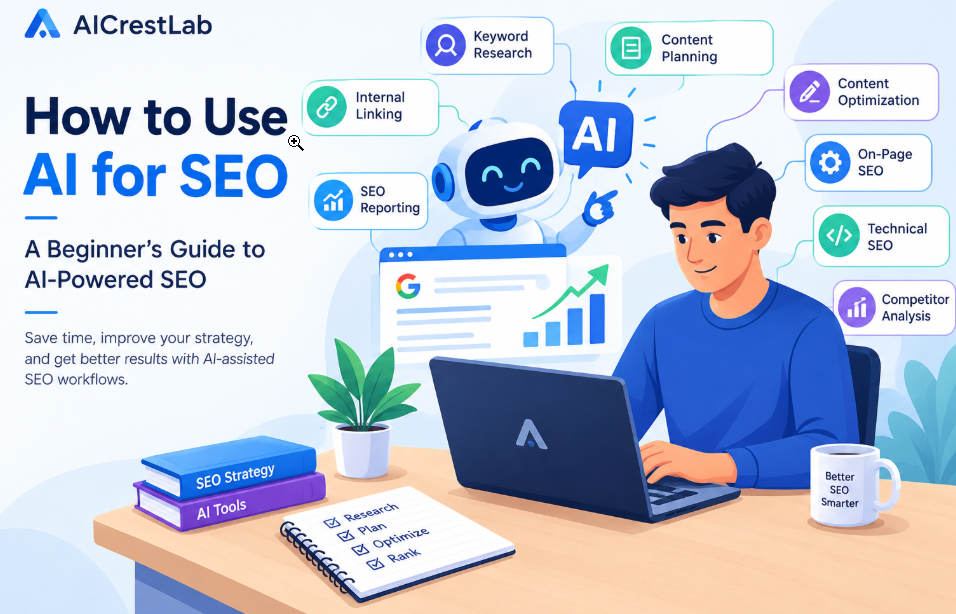
Search engine optimization often means doing a lot of research, analysis and content work. You have to find keywords. You have to understand what people want when they search. You have to plan how to structure articles. You have to improve existing pages. You have to fix problems. You have to look at performance data. All of this can take hours if you do it by hand. It’s a lot of work. It’s important for getting noticed online.
Artificial intelligence is changing how many SEO professionals, website owners, and content creators approach these tasks.
Modern AI tools can help you analyze amounts of information organize keyword ideas find potential content gaps improve drafts summarize SEO data and assist with technical tasks.. Using AI for SEO effectively does not mean handing your entire SEO strategy over to an AI system.
What Does It Mean to Use AI for SEO?

Using AI for SEO means applying artificial intelligence technologies to support different search engine optimization tasks.
These technologies can include large language models, machine learning, natural language processing (NLP), computer vision, and automated data analysis.
Instead of replacing traditional SEO, AI can help make many parts of the process faster and more efficient.
For example, an SEO professional might use AI to:
- Generate initial keyword ideas
- Group related keywords into topic clusters
- Analyze search intent
- Create content outlines
- Identify missing subtopics
- Improve readability
- Generate meta description ideas
- Analyze SEO reports
- Suggest internal links
- Explain technical SEO problems
The important distinction is that AI can assist with the work, but the final strategic decisions should still be reviewed by a person.
AI-Assisted SEO vs. Fully Automated SEO
There is a significant difference between using AI as an assistant and completely automating your SEO operation.
AI-assisted SEO means AI helps with individual tasks while a human reviews the output. For example, you might ask AI to organize a keyword list, then use an SEO platform to verify search volume and competition.
Fully automated SEO attempts to remove humans from most or all of the process. A workflow might generate an article, optimize it, and publish it automatically without editorial review.
The second approach can create problems when the AI produces inaccurate information, generic content, outdated claims, or pages that provide little additional value.
For most websites, a human-in-the-loop approach is safer and more effective.
A Simple Example
Suppose you want to write an article about machine learning applications.
Doing the research manually could involve:
- Finding competing articles
- Reviewing their headings
- Collecting related questions
- Identifying important concepts
- Building an outline
- Researching reliable sources
AI can speed up several of these early stages.
You could use an AI model to brainstorm related topics, organize potential keywords, classify questions by search intent, and suggest an initial outline.
You would then verify the information, examine actual search results, add your own expertise, and create the final article.
This is where AI becomes useful: it reduces repetitive work without removing the human from the SEO process.
How Can AI Help With SEO?
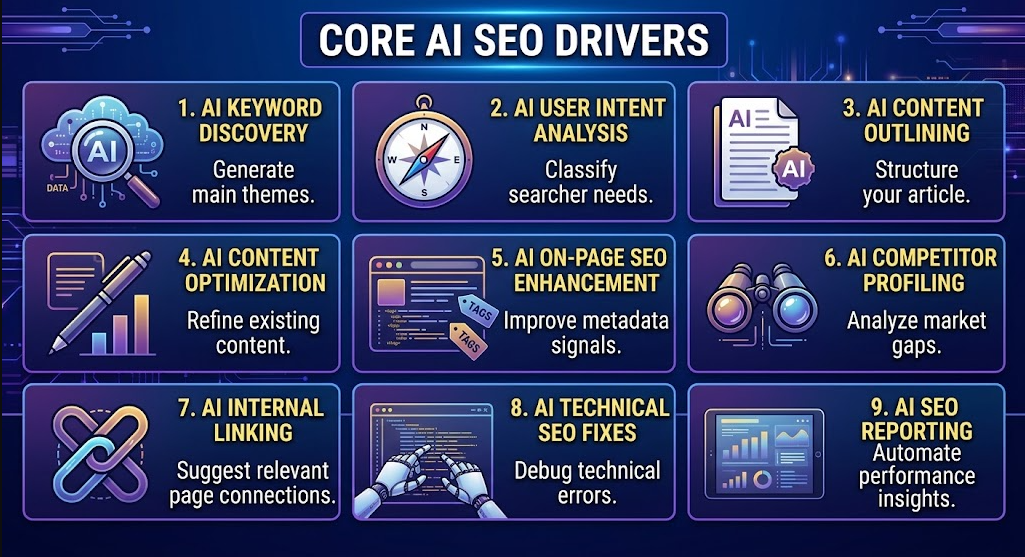
AI can assist with many areas of search engine optimization. However, its usefulness depends on the task and the quality of the information provided to the system.
Here are some of the most practical applications.
1. Keyword Research
Keyword research is one of the most common areas where AI can save time.
Instead of starting with a single keyword and manually brainstorming hundreds of variations, you can ask AI to generate related search phrases, questions, topics, and long-tail keyword ideas.
AI can help you:
- Discover related keyword variations
- Generate long-tail search queries
- Group similar keywords
- Identify questions users may ask
- Create potential topic clusters
- Expand a seed keyword into related subjects
For example, if your main topic is “AI automation,” AI could help generate related topics such as AI workflow automation, AI automation tools, AI automation for small businesses, AI automation examples, and AI workflow software.
However, AI-generated keyword ideas should not automatically be treated as real search data.
AI does not inherently provide reliable, real-time information about:
- Search volume
- Keyword difficulty
- Click-through rates
- Current rankings
- Backlink competition
Use dedicated SEO platforms or search data to validate these metrics before making major content decisions.
2. Understanding Search Intent
Ranking for a keyword is not simply about mentioning that keyword enough times.
Your content also needs to satisfy what the searcher is actually trying to accomplish.
Search intent generally falls into several broad categories:
- Informational: The user wants to learn something.
- Navigational: The user wants to find a particular website or page.
- Commercial: The user is researching products or services before making a decision.
- Transactional: The user is ready to take an action such as buying, subscribing, or downloading.
AI can help classify keyword lists according to likely intent.
For example:
| Search Query | Likely Intent |
|---|---|
| What is AI automation? | Informational |
| Best AI automation tools | Commercial |
| Zapier pricing | Commercial |
| Buy automation software | Transactional |
AI can also help compare the structure and format of ranking pages to determine what type of content searchers appear to prefer.
Still, you should manually review the actual search results because search intent can be more nuanced than a simple category.
3. Creating SEO Content Outlines
Creating a useful outline before writing can make a major difference to the quality of an article.
AI can analyze a topic and suggest:
- H2 and H3 sections
- Related questions
- Supporting concepts
- Potential FAQs
- Logical content flow
- Topics competitors commonly cover
For example, instead of simply asking:
“Write an article about AI SEO.”
You can ask AI to help organize the subject into sections such as keyword research, search intent, content optimization, technical SEO, internal linking, reporting, benefits, limitations, and practical workflows.
However, an AI-generated outline should be treated as a starting point.
Review the structure and remove unnecessary sections. Add topics that are particularly relevant to your audience and include information based on your own experience or research.
4. Content Optimization
AI can also be useful after an article has already been written.
Content optimization tools can help identify:
- Missing subtopics
- Related terminology
- Areas that need clarification
- Difficult or overly long sentences
- Repetitive sections
- Structural problems
- Potential content gaps
AI can therefore help you improve an existing article rather than only generating new content.
For example, if an article explains AI agents but does not explain how they differ from traditional automation, AI could flag the missing comparison as an opportunity to make the article more complete.
The goal should not be to maximize keyword frequency.
A better goal is to make the article clearer, more complete, useful, and relevant to the reader’s question.
5. On-Page SEO
On-page SEO covers the elements of an individual webpage that help search engines and users understand its content.
AI can assist with tasks such as:
- Meta title ideas
- Meta descriptions
- Image alt text
- Heading improvements
- FAQ suggestions
- Content summaries
- Internal anchor-text ideas
- Basic structured-data drafts
For example, after completing an article, you can ask AI to generate several meta description options and then choose the one that accurately represents the page.
AI should not be used to create misleading titles or descriptions simply because they might attract clicks.
Your metadata should accurately communicate what the page actually contains.
Example of AI-Assisted On-Page Optimization
Imagine you have written a software review.
You can ask AI to create several concise meta descriptions that:
- Clearly describe the article
- Include the primary topic naturally
- Encourage clicks
- Stay within an appropriate length
- Avoid exaggerated claims
You can then edit the best option before publishing.
6. Competitor Research
Studying competing content can help reveal what users expect from a topic.
AI can make this process faster by helping you compare publicly available information.
For example, AI can help identify:
- Common headings
- Frequently discussed topics
- Questions competitors answer
- Topics that appear to be missing
- Differences in content structure
- Potential opportunities to provide additional value
The purpose is not to copy competitors.
Instead, use competitor analysis to understand the current content landscape and find ways to create something more useful.
Your article should add original explanations, examples, research, experience, visuals, or other useful information rather than simply rewording another website’s content.
7. Internal Linking
Internal links connect pages within your own website.
They can help users discover related content and help search engines understand relationships between different pages.
AI can assist by reviewing your existing content and suggesting relevant pages to connect.
For example, an article about AI SEO might naturally link to:
- Best AI SEO Tools
- Best AI Writing Tools
- Best AI Productivity Tools6. Competitor ResearchStudying competing content can help reveal what users expect from a topic.AI can make this process faster by helping you compare publicly available information.For example, AI can help identify:
- Common headings
- Frequently discussed topics
- Questions competitors answer
- Topics that appear to be missing
- Differences in content structure
- Potential opportunities to provide additional value
- AI Automation
- AI Agents
The important part is context.
Do not add internal links simply to increase the number of links on a page. Each link should help the reader understand the current topic or continue exploring a related subject.
8. Technical SEO Assistance
Technical SEO can involve crawling, indexing, structured data, redirects, site architecture, page performance, and other technical components.
AI can be useful for explaining technical concepts and assisting with certain technical tasks.
For example, it can help:
- Explain crawl errors
- Interpret common HTTP status codes
- Review snippets of HTML
- Draft basic
robots.txtrules - Explain XML sitemap structures
- Generate basic Schema.org JSON-LD
- Identify possible coding problems
- Explain technical SEO terminology
However, technical changes should be tested before being deployed to a production website.
For structured data, you can use Google’s Rich Results Test to check whether eligible markup is recognized correctly.
AI can help write or explain technical code, but it should not replace testing and technical review.
9. SEO Reporting and Data Analysis
SEO platforms can produce large amounts of data.
Google Search Console, analytics platforms, rank trackers, and other SEO tools may provide thousands of rows of queries, clicks, impressions, pages, and positions.
AI can help turn this raw information into something easier to understand.
For example, AI can help:
- Summarize performance trends
- Identify pages gaining or losing traffic
- Group similar search queries
- Categorize keywords by intent
- Highlight unusual changes
- Organize spreadsheet data
- Prepare reporting summaries
For reliable analysis, provide AI with actual exported data instead of asking it to guess current SEO metrics.
How to Use AI for SEO: Step-by-Step Workflow
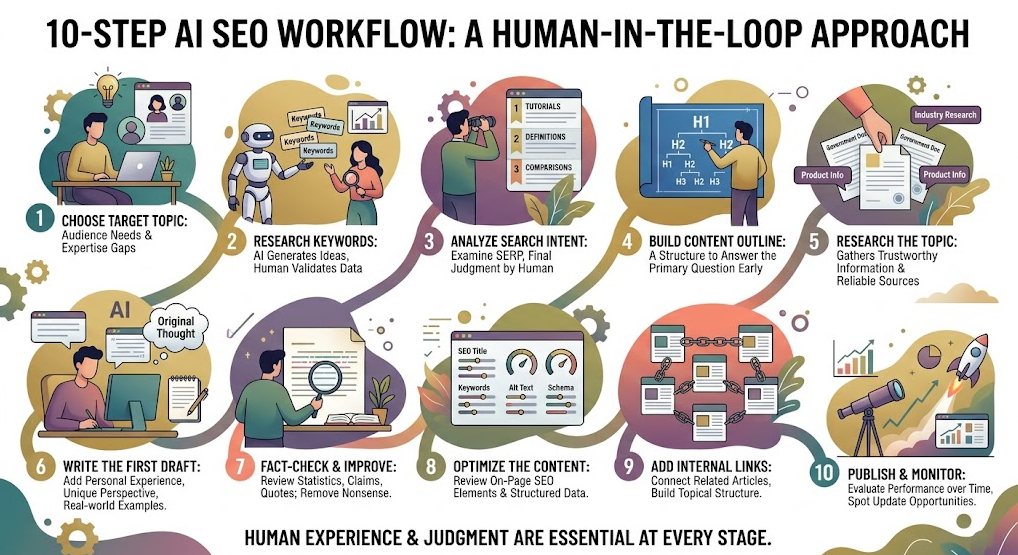
A structured workflow makes AI much more useful.
Instead of asking an AI model to “do SEO,” divide the process into individual tasks.
Step 1: Choose a Target Topic
Start with a topic that is genuinely useful to your audience.
Consider:
- Questions your audience asks
- Problems your product solves
- Topics related to your expertise
- Existing content gaps
- Search demand
- Business relevance
A good SEO topic should serve both the reader and the broader purpose of your website.
Step 2: Research Keywords
Give AI a broad topic and ask it to generate related search terms.
Then validate those suggestions using actual SEO data.
Check factors such as:
- Search volume
- Competition
- Search intent
- Trends
- Business relevance
AI is particularly useful for expanding and organizing keyword lists, while dedicated SEO tools are better suited for validating keyword metrics.
Step 3: Analyze Search Intent
Search the primary keyword and examine the current results.
Ask:
- What type of pages are ranking?
- Are users looking for definitions?
- Do they want tutorials?
- Are comparison pages common?
- Are product pages appearing?
- What questions do the results answer?
Use AI to help organize these observations, but make the final judgment yourself.
Step 4: Build a Content Outline
Once the topic and intent are clear, create the article structure.
A useful outline should:
- Answer the primary question early
- Cover important supporting topics
- Use logical H2 and H3 sections
- Include examples where useful
- Avoid unnecessary sections
AI can produce the initial structure, while you refine it based on your audience and research.
Step 5: Research the Topic
Before writing, gather trustworthy information.
Whenever possible, prioritize:
- Official documentation
- Government sources
- Original research
- Industry organizations
- First-party product information
- Reliable technical references
This is especially important for pricing, product features, statistics, technical specifications, and claims about search engines.
Step 6: Write the First Draft
AI can help generate an initial draft, but you can also write the content yourself and use AI primarily for editing.
Whichever approach you use, add information that makes the article genuinely yours.
This could include:
- Personal experience
- Practical examples
- Screenshots
- Original comparisons
- Testing observations
- Unique explanations
- Real-world workflows
These elements can make content more useful than generic AI-generated text.
Step 7: Fact-Check and Improve
Never assume that an AI-generated statement is automatically correct.
Review:
- Statistics
- Product features
- Prices
- Dates
- Technical claims
- Quotes
- Links
- Software capabilities
Remove unsupported claims and rewrite sections that sound generic or repetitive.
Step 8: Optimize the Content
After the article is fact-checked, review its on-page SEO.
Check:
- SEO title
- Meta description
- Primary keyword
- Supporting keywords
- H1
- H2/H3 structure
- Image alt text
- Internal links
- External references
- FAQs
- Schema markup where appropriate
Optimization should improve the page rather than make the writing unnatural.
Step 9: Add Internal Links
Connect the new article with relevant pages already published on your website.
Also look for older articles that should link back to the new page.
This creates a stronger topical structure and helps users navigate between related resources.
Step 10: Publish and Monitor
After publishing, monitor how the page performs.
Google Search Console can help you evaluate:
- Impressions
- Clicks
- Average position
- CTR
- Search queries
- Page performance
Do not judge an article only a few days after publication.
SEO performance can change over time, and the data you collect can reveal opportunities for future updates.
Example: Using AI to Improve an Existing SEO Article
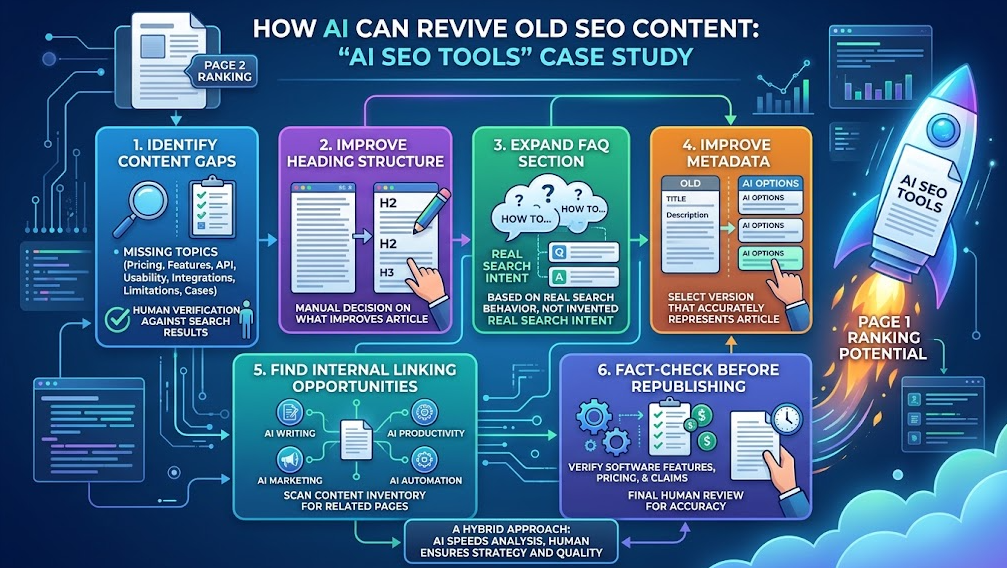
Suppose you have an older article targeting the keyword “AI SEO Tools”.
The article receives impressions but remains around the second page of search results.
Instead of immediately creating another article, you could use AI to help audit the existing page.
1. Identify Content Gaps
Give the article to an AI tool and ask it to identify important topics that may be missing.
Potential gaps could include:
- Pricing
- Features
- API access
- Beginner usability
- Integrations
- Limitations
- Real-world use cases
Verify each suggested gap against actual search results before adding it.
2. Improve the Heading Structure
AI can identify overly long sections and suggest clearer H2 and H3 structures.
You can then manually decide which changes actually improve the article.
3. Expand the FAQ Section
AI can help turn relevant user questions into concise FAQ drafts.
The questions should be based on genuine search behavior or reader needs rather than invented simply to increase page length.
4. Improve Metadata
Ask AI for several SEO title and meta description options.
Choose the version that accurately represents the updated article.
5. Find Internal Linking Opportunities
AI can scan your content inventory and suggest related pages.
For example, an AI SEO article may naturally connect to articles about AI writing tools, AI productivity tools, AI marketing tools, and AI automation.
6. Fact-Check Before Republishing
Finally, verify software features, pricing, screenshots, links, and technical claims before updating the page.
What Should AI Do in SEO—and What Should Humans Do?
AI is powerful, but not every SEO responsibility should be delegated to it.
| SEO Task | AI Can Help With | Human Review Should Handle |
|---|---|---|
| Keyword Research | Generate ideas and clusters | Verify search demand and business value |
| Search Intent | Categorize queries | Evaluate actual search results |
| Content Outlines | Suggest H2/H3 structures | Decide what readers genuinely need |
| Writing | Draft and edit text | Add expertise and original insights |
| On-Page SEO | Suggest titles, descriptions, and alt text | Ensure accuracy and natural language |
| Fact-Checking | Organize supplied information | Verify claims against reliable sources |
| Technical SEO | Explain errors and draft code | Test changes before deployment |
| Internal Linking | Find possible related pages | Select links that make contextual sense |
| Competitor Analysis | Summarize public information | Develop an original content strategy |
| SEO Reporting | Process and summarize datasets | Make strategic decisions |
The most effective workflow is usually a collaboration between AI efficiency and human expertise.
AI SEO vs. Traditional SEO
AI does not eliminate the fundamental principles of SEO.
Traditional SEO still depends on understanding search intent, creating useful content, improving website accessibility, building authority, and providing a good user experience.
The main difference is how much of the research and analysis can be accelerated.
Traditional workflows may require manually reviewing dozens of pages, organizing spreadsheets, and preparing reports.
AI-assisted workflows can automate or accelerate portions of that work.
This gives SEO professionals more time to focus on strategy, originality, research, and user experience.
AI SEO vs. AI Automation
AI SEO and AI automation are related but are not exactly the same thing.
AI-assisted SEO uses AI to help with individual SEO activities.
For example:
- Keyword brainstorming
- Content outlines
- Meta descriptions
- Content editing
- Internal link suggestions
AI automation for SEO connects several steps into an automated workflow.
For example:
Keyword added to spreadsheet → AI analyzes topic → content brief created → draft generated → human review requested → WordPress draft created.
Automation can save significant time, but completely hands-off publishing introduces additional risks.
For a broader explanation of automated workflows, see our guide to AI automation.
AI SEO vs. AI Agents
AI agents take the concept of AI-assisted work further.
A conventional AI tool generally waits for a prompt and produces an answer.
An AI agent can be designed around a goal and may decide which actions or tools it needs to use to reach that goal.
For example, an SEO-focused agent could potentially:
- Monitor search performance
- Detect ranking changes
- Investigate affected pages
- Analyze competing content
- Identify possible content gaps
- Prepare an optimization plan
- Present the recommendations for approval
The difference is primarily the level of autonomy and decision-making involved.
You can learn more about the broader concept in our AI agents guide.
Benefits of Using AI for SEO
When implemented carefully, AI can provide several practical advantages.
1. Saves Time
AI can reduce the amount of time spent on repetitive research, formatting, brainstorming, and data organization.
2. Speeds Up Research
Large amounts of text and structured information can be processed much faster than manually reviewing every item.
3. Generates New Ideas
AI can help when you need additional article topics, supporting questions, keyword variations, or content angles.
4. Improves Content Structure
AI can identify overly long sections, suggest clearer headings, and make content easier to scan.
5. Handles Large Datasets
SEO exports can contain thousands of queries and URLs. AI can help categorize and summarize that information.
6. Supports Internal Linking
AI can identify potential relationships between articles and suggest contextual linking opportunities.
7. Helps Maintain Publishing Consistency
By reducing repetitive work, AI can help smaller teams maintain a more consistent content workflow.
8. Makes SEO Work More Scalable
A small team can use AI to handle some research and analysis tasks that would otherwise require significantly more manual effort.
Limitations of AI for SEO
AI can improve SEO workflows, but it also has important limitations.
1. AI Can Produce Incorrect Information
Language models can generate convincing but inaccurate statements.
This is particularly dangerous when an article contains:
- Statistics
- Product specifications
- Prices
- Technical instructions
- Medical or financial information
- Claims about search engine algorithms
Always verify important claims.
2. AI Content Can Become Generic
If many websites use similar prompts, their content can start to sound remarkably similar.
Human editing and original research are important for creating distinctive content.
3. AI Does Not Have Genuine Firsthand Experience
An AI model cannot genuinely test a software product, interview a customer, or operate a business unless it is connected to systems that provide those experiences or data.
Do not present invented experiences as real ones.
4. AI Does Not Automatically Know Live SEO Metrics
A language model cannot reliably provide current keyword volume, rankings, backlinks, or CTR without access to appropriate data sources.
Use real SEO datasets for these decisions.
5. Audience Nuance Can Be Difficult
AI may struggle to understand highly specific audiences, regional preferences, brand voice, or subtle industry expectations unless you provide sufficient context.
6. AI Cannot Guarantee Rankings
No AI tool can guarantee that an article will reach position one.
Search performance depends on many factors, including content quality, relevance, competition, technical health, authority, and user satisfaction.
Risks of Using AI for SEO
Using AI without proper editorial controls can create problems.
Inaccurate Information
Publishing incorrect AI-generated claims can damage both rankings and reader trust.
Repetitive Content
Mass-producing similar articles can create a large collection of pages with little unique value.
Keyword Stuffing
AI may repeatedly insert a target keyword if instructed to prioritize keyword usage too aggressively.
Loss of Brand Voice
Publishing raw AI output can make a website sound generic and disconnected from its actual audience.
Uncontrolled Automation
Automatically generating and publishing large quantities of AI content without human review can make errors difficult to detect.
How to Reduce These Risks
A safer AI SEO workflow should include:
- Human editorial review
- Fact-checking
- Reliable sources
- Original research where possible
- Real examples
- Screenshots and demonstrations when appropriate
- Careful keyword usage
- Manual approval before publication
The goal is not to avoid AI. The goal is to use it responsibly.
What Types of Tools Support AI-Powered SEO?
An effective AI SEO workflow can involve several different types of software.
All-in-One SEO Platforms
These tools combine keyword research, competitor analysis, ranking data, site audits, and other SEO functions.
Generative AI Tools
Large language models can help with brainstorming, outlines, editing, summaries, metadata, and content analysis.
Content Optimization Platforms
These systems can compare content against competing pages and provide recommendations about topics, terminology, and structure.
Technical SEO Tools
Website crawlers and diagnostic platforms can identify problems such as broken links, duplicate content, redirects, indexing issues, and other technical concerns.
If you want to compare different platforms, see our guide to the best AI SEO tools.
How Beginners Can Start Using AI for SEO
You do not need to automate your entire SEO process on day one.
Start with low-risk tasks and gradually expand.
Beginner Level
Start with simple tasks such as:
- Brainstorming article topics
- Generating keyword variations
- Creating content outlines
- Writing meta description drafts
- Improving readability
These tasks are relatively easy to review.
Intermediate Level
Once you are comfortable, AI can help with:
- Content gap analysis
- Internal linking
- Competitor research
- Search intent classification
- Content optimization
- SEO reporting
Advanced Level
More advanced workflows may include:
- Processing large Search Console exports
- Generating structured data
- Connecting AI with SEO APIs
- Building automated content audits
- Creating custom SEO assistants
- Connecting AI with workflow automation platforms
At this stage, testing and permissions become increasingly important.
Practical AI SEO Workflow for AICrestLab
For a technology website such as AICrestLab, an AI-assisted SEO workflow can look like this:
1. Identify a Target Topic
Start with a technology topic that is relevant to the site’s audience.
2. Generate Related Ideas
Use AI to brainstorm related keywords, questions, entities, and potential subtopics.
3. Validate Search Demand
Use actual SEO data to evaluate search volume, competition, trends, and intent.
4. Analyze Search Results
Review competing pages and identify what users are currently being offered.
5. Build the Content Structure
Create an outline that directly addresses the main query and covers relevant supporting questions.
6. Research and Write
Use trustworthy sources and add original explanations, examples, testing notes, and useful context.
7. Fact-Check
Verify important technical claims, product information, pricing, and other potentially changing information.
8. Optimize the Page
Review the title, meta description, headings, images, alt text, internal links, and other on-page elements.
9. Publish
Publish the article only after editorial review is complete.
10. Monitor Performance
Use Google Search Console and other SEO tools to monitor impressions, clicks, queries, CTR, and rankings.
This approach keeps AI in the role of an assistant rather than allowing it to make every SEO decision independently.
Frequently Asked Questions What is AI SEO?
AI SEO means using artificial intelligence technologies to assist with search engine optimization activities such as keyword research, content planning, content optimization, technical analysis, internal linking, and SEO reporting.
How can I use AI for SEO?
You can use AI to brainstorm keywords, organize topic clusters, analyze search intent, create content outlines, improve drafts, generate metadata, identify internal linking opportunities, analyze SEO datasets, and assist with technical SEO tasks.
Can AI do SEO by itself?
Not reliably. AI can automate or accelerate many individual SEO tasks, but successful SEO still requires strategy, human judgment, fact-checking, original insights, and ongoing performance analysis.
Is AI good for SEO?
Yes. AI can be very useful for repetitive research, content organization, data analysis, and editorial assistance. Its effectiveness depends on how it is used and how carefully its output is reviewed.
Can AI-generated content rank on Google?
AI-generated content can appear in search results, but using AI does not guarantee rankings. The important factors are whether the content is useful, accurate, relevant, original enough to provide value, and created to satisfy users rather than manipulate search rankings.
Can AI replace SEO professionals?
AI can automate portions of SEO work, but it does not eliminate the need for human strategy, expertise, editorial judgment, research, and decision-making.
How does AI help with keyword research?
AI can generate keyword variations, discover related questions, organize terms into topic clusters, and classify search intent. Actual search volume and competition should be checked using reliable SEO data.
Can AI optimize existing content?
Yes. AI can review existing articles for structural issues, missing subtopics, readability problems, repetitive language, metadata improvements, and potential internal links.
Can AI help with internal linking?
Yes. AI can analyze your website’s existing content and identify pages that are contextually related to a new article. The final links should still be reviewed manually to ensure they genuinely help readers.
What are the best AI SEO tools?
Popular options include comprehensive SEO platforms such as Semrush and Ahrefs, content optimization platforms such as Surfer SEO and Clearscope, and general AI assistants such as ChatGPT, Claude, and Google Gemini.
For a more detailed comparison, see our guide to the best AI SEO tools.
Is AI SEO safe for a website?
AI-assisted SEO can be safe when used responsibly. Avoid publishing large amounts of unverified or low-value content automatically. Fact-check important information and keep human review in the publishing process.
How should beginners start using AI for SEO?
Start with simple tasks such as keyword brainstorming, content outlining, editing, and meta description generation. Once you understand the workflow, gradually introduce content analysis, internal linking, reporting, and more advanced automation.
Conclusion
AI is becoming a useful part of modern search engine optimization, particularly for research, organization, content analysis, and repetitive tasks.
It can help SEO teams brainstorm keywords, understand search intent, create outlines, analyze content gaps, improve on-page elements, process large datasets, and discover internal linking opportunities.
But AI should not be treated as a replacement for SEO expertise.
The strongest approach is to combine AI’s speed and processing capabilities with human research, experience, editorial judgment, and fact-checking.
Instead of asking AI to handle your entire SEO strategy, use it where it provides the most value. Let it process information, generate possibilities, identify patterns, and reduce repetitive work—then use human judgment to decide what should actually be published.
For beginners, the best starting point is simple: choose one repetitive SEO task, introduce AI into that step, verify the results, and gradually build a workflow that improves both efficiency and content quality.
SEO is still about helping people find useful information. AI can make that process faster, but the responsibility for creating genuinely valuable content remains with the people behind the website.
Also Read: 25 Best Free AI Tools: Top Picks Compared

Hammad Ali is an AI and technology enthusiast who writes about Generative AI, AI tools, automation, and emerging technologies in simple, practical language.